Researched and Written by Dario Coletta 2026
Beginnings
With Lexington’s “shot heard around the world” still echoing throughout New England, one back country area of Massachusetts known as Plantation #5 was being transformed by the arrival of intrepid settlers from the east. Despite the uncertainty and turbulence of the war around them, these yeoman farmers were eager to put down new roots and escape the limited future they saw for themselves in their home towns.
Emblematic of these pioneers were Samuel Streeter and his younger brothers Daniel and Asa. Of the brothers, Samuel (1754-1844) bought land first in the northern section of this plantation in 1778 and again in 1779. By this time, sufficient settlement had occurred in the region that the district was incorporated as the Town of Cummington. John Cuming, its namesake, had purchased Plantation #5 at auction in 1762 for £1800 and had then subsequently sold it off in lots to about 30 proprietors. Cummington was located in the highlands west of the Connecticut River, bisected west to east by the east branch of the Westfield River, a tributary of the Connecticut. Although less than 25 miles west from the 120 year old river town of Northampton, this land was still unsettled: a remote, rugged, multiple-day journey on bridle paths from the Connecticut River valley.
From the beginning, the Westfield River made transport and communication difficult between the northern and southern portions of Cummington. This was especially true for those in the north traveling weekly to church, as the meeting house was on top of a steep hill on the far side of the river. Attendance at church was mandatory, and as a consequence, six years after Cummington was incorporated, most of the land on the north side of the river was separated and established as the Town of Plainfield in the spring of 1785.
Why focus this short history around the person of Samuel Streeter? Like most of his peers he has left us
no diary, letters or personal records that we know of. We have only town meeting minutes, deeds, census
lists and newspaper notices to help discern his character. His politics, hopes and fears for himself and his
family in this newly settled land are opaque at best. What we do know is that Samuel Streeter — perhaps
more than anyone else — was at the center of things, both geographically and culturally, from the moment he arrived in the late 1770s in what would become the town of Plainfield.
When Samuel Streeter bought his land, first-growth forest was quickly being cleared for house lots,
buildings and the enormous amounts of firewood necessary to cook year round and keep homes warm
during the long winter months. During the Revolutionary War period most men were militia members and
the younger ones, like Samuel and his brothers, minute men.1 Despite this commitment to their country
and to their family at home in Sturbridge, they still found time to travel west and work on developing
Samuel’s land.
During this time, in 1779, Samuel married Bathsheba Barton (1767 – 1838) in Charlton MA and he would have traveled the 70 miles back and forth seasonally, both before and after his marriage to establish his homesite. The trees used for the timbers of his house were cut in winter when the snow made moving them easier, and in the spring and summer they would be shaped, assembled and the frame of the house raised. Once this homestead was enclosed Bathsheba and the children could be sent for. One of the requirements in establishing a legal town in Massachusetts obligated settlers to build houses at least 18′ by 24′ with a 7-ft. stud for wall height.2 In addition, seven acres were to be cleared and under cultivation within five years. A tall order to be sure, but not discouraging to many as hard manual labor was the norm for adults and children. By 1790 most of the best land had already been cleared for crops, pasturage and haying, but much of the town’s uneven land remained heavily forested.3
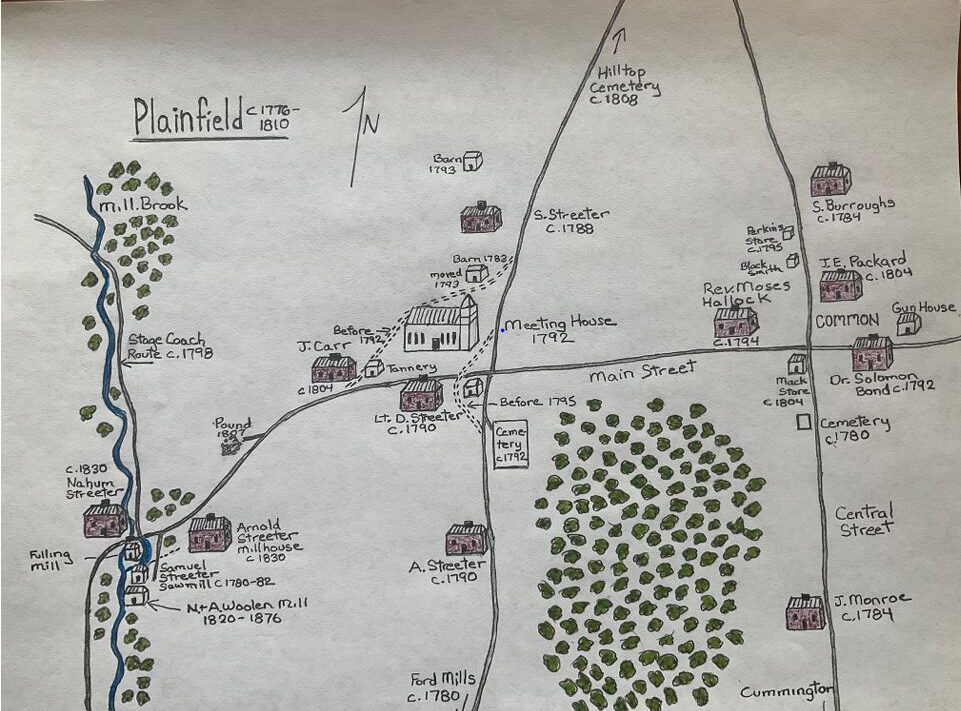
By the time Cummington was established in 1779, the focus of settlement at its northern end was coalescing around two crossroads on Main Street (now Route 116). The road ran across the south facing
shoulder of one of the innumerable hills in the area, a good 1600 feet above sea level. This location was
not by accident as it was still thought that the best places to settle were on the tops of hills, as the valleys,
riversides, and marshes were feared to be pestilential and were prone to floods. 4The numerous springs on the top of this hill also made it attractive for settlement.
Samuel had bought two lots of roughly 100 acres each on the north side of the western crossroads. This
area was soon to be known as the Lower Village as it was on the downslope from its counterpart to the
east, the Upper Village. The lots in this part of town were long rectangles running east-west, a portion of
the area known as the Hatfield Equivalent which occupied much of the central part of the town.5 With lots 200 rods long (3300 ft.), Samuel’s first lot (#70) extended west to the Mill Brook at the bottom of a steep
hill west of the crossroads. As this land included one of the best power sites on the largest stream in town, Samuel knew he had an invaluable piece of property when he had it surveyed. The following year he bought a larger lot just above this one (#69), and within a short time, perhaps as early as 1780 and certainly by 1782, he had built and was operating a sawmill there. 6 Samuel must have prioritized this work along with building his house as the sawn boards, shingles and clapboards produced by his mill would have been in high demand as the settlers’ early log cabins were transitioning into timber-framed and cladded houses; many of the houses in the surrounding area would be built with his lumber. Likewise gristmills were an early necessity to supply the bread that the settlers craved. The first gristmill was established around the same time as Samuel’s mill, about a mile farther south down the Mill Brook and run by the Ford brothers. Not surprisingly, most hamlets had sawmills and gristmills long before there were churches and taverns.
The early 1780s were a time of rapid development in Cummington as the Revolutionary War was winding down. The end of the war accelerated the settling of interior lands in New England and most of the lots by the crossroads and elsewhere in town continued to be sold by the proprietors. A few years after Samuel settled, his brothers Daniel and Asa bought the lots directly below his, south of Main Street, where they built houses which still stand today. Daniel (1756-1792), a Lieutenant in the revolutionary militia, was a saddler, and Asa (1762-1821), a farmer. In 1802 after his first wife died, Asa relocated to what is now Stage Road in Cummington where his farm still remains in the family today. All three brothers are listed on the earliest existing Cummington bridge tax roles of 1784.
Samuel and Bathsheba had ten children, the first in 1780, all but one surviving into adulthood. In the late 18th century modern medicine was in its infancy, and with high mortality rates in babies and children the norm, the Streeters must have considered themselves fortunate. Samuel’s own twin sister had died at six months of age, and growing up he was well aware of life’s fragility.
In these early days of settlement, small neighborhoods sprang up such as the one surrounding the Lower Village. Here each family necessarily took great interest in their neighbors, working communally, connecting themselves around anchor farms run by well-to-do farmers who had the means and wherewithal to improve their operations and sell products to their neighbors. In a pre-industrial society like this almost all families farmed to supply their food, clothing and materials essential to survival. Post war times were difficult, and with money nonexistent, bartering for products and services was customary. These more prosperous settlers could also act as a safety net for the less fortunate members of the community, supporting them sometimes for years until their situation improved. Even manufacturers like the Streeters were farmers who needed to fully cultivate their acreage and plant apple orchards to supply cider to maintain themselves and their livestock. Samuel Streeter, possessor of one of these anchor farms, sustained his neighbors, especially his brothers as they bought land and settled in the mid 1780s.7
While not required, it was expected that most men fulfill the numerous jobs necessary to run the town. The Streeter brothers were no exception. Along with four other men, Samuel’s first official town position was that of Surveyor of Highways in 17878, and his first church position was that of Tythingman in 1789.9 In the next year he was on the committee to build a bridge on the brook just above his mill, and also part of another committee to build a school house in the northern district. Three school districts were established in town with School #1 put up north of Simon Burroughs’s house in the Upper Village in 1790.
Although the era of town commons with communal grazing land was already outdated by the late 18th century, a town common was mentioned in Upper Village deeds well into the next century. Lying in the northeast quadrant of the Upper Village crossroads, this land’s first owner was the above mentioned Simon Burroughs (1751-1833). A blacksmith and veteran, he bought lot #18 quite early, in 1776. Simon allowed the town to use part of his flat stretch of land as a militia training ground during and after the revolutionary period, and over the years it came to be known informally as the common. In 1810 Simon sold a small piece of this land to contain the town’s first gun house, a 20′ by 20′ structure, continuing the common’s military use beyond the War of 1812.10
Jonathan Monroe was the first landowner (1778) south of Main Street in the Upper Village, and ten years later he sold the southeast corner of the crossroads to Dr. Solomon Bond who built a house near the intersection. Solomon was the first doctor to settle in the district, but given the limited resources of his neighbors and the remoteness of the settlement, he soon opened what may have been the first store in town. Despite this, by 1797 he had relocated his growing family to the more populous, and hopefully more lucrative town of Enfield, CT. Through the years numerous shops and stores cycled through both crossroads as many settlers, even professionals, needed a “side line” to stay afloat. Often these businesses were literally moved to different spots in the crossroads as their ownership changed.
Shays’s Rebellion
At this point it would be remiss not to mention the dissatisfaction that had been growing in the western backcountry sections of the state during the 1780s, culminating in Shays’s Rebellion in 1786-1787. Insufferably high property and poll taxes mandated by the state in 1782 were adversely affecting all but the most wealthy.11 A notice in the Hampshire Gazette that year notes that 20 lots in the Hatfield Equivalent of Cummington owed back taxes. To yeomen, husbandmen and laborers, these taxes felt unduly burdensome, and it seemed that the privileged class was now controlling the state government. Hadn’t a war just been fought to throw off this type of tyranny? The rebellion culminated with Daniel Shays’s force of 1200 men attacking the Springfield Armory and being subsequently routed in January of 1787. Samuel Streeter’s name appears on the Oath of Allegiance list that Massachusetts required Cummington and Plainfield men to sign in the wake of the failed rebellion. This document dates from late 1786 to early 1787 and lists 83 militia men who, although having eschewed violence, needed to be granted conditional amnesty for having been sympathetic to the rebellion. This two-sided document divides the men by which side of the Westfield River they lived on, with the majority living to the north. Although now separate entities, the two towns were still closely aligned and the river still difficult to cross, resulting in both towns’ militia men being included on one list. Intriguingly, Samuel’s name tops the list of the 50 men living north of the river. In Only One Cummington, author Bill Streeter, a sixth generation nephew of Samuel, speculates that as one of the militia’s training grounds was at or near Samuel’s house, and as he was known to have been very active in the Massachusetts militia, he could have been one of the local leaders of the rebellion. Given his age of 32, and despite his relative affluence, he must have sympathized with his fellow yeomen neighbors, most of whom were young and suffering severe financial hardships after the war. As an active veteran, a successful manufacturer and a community leader, he was someone others could naturally rally around. Emblematic of these hard times were the notices that appeared in the Hampshire Gazette in the 1780s and 1790s of Plainfield proprietors whose land taxes had been in delinquent for years. Failure to pay these debts would eventually result in their properties being confiscated. In 1791 many of them were auctioned off at Isaac Joy’s tavern, down Central Street from the Upper Village. The economic situation only started to improve and stabilize in the mid 1790s as trade networks were slowly rebuilt and the federal government finally settled its foreign debt in 1795.
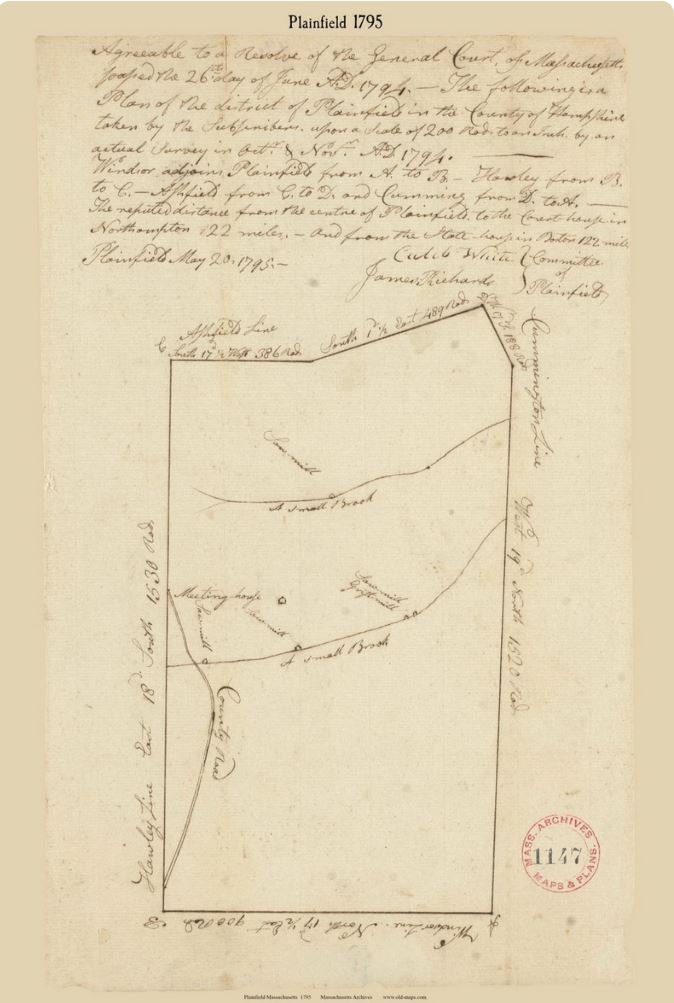
Centering the Town So where was the center of the village to be sited? When this question was brought up in town meetings from 1786-1788, it was always associated with the location of the meeting house. Consequently, a committee of citizens living in disparate areas of town was appointed “to measure and find the center of Plainfield, and likewise to agree upon a place which they shall feel most proper for erecting a meeting house upon.” Just as the yeomen had their requirements for settlement, the town’s most important duty, in addition to the funding of schools, was to settle a Protestant minister and build a meeting house. Massachusetts had long mandated that every town establish a “holy commonwealth” where civics and religion were combined. Since the town’s creation, two ministers had been “called to settle,” but neither had worked out in the longterm.
The successive locations of Plainfield’s town meetings offer a clue to the evolution of the establishment of the town’s center. The first Plainfield town meeting in March of 1785 was at Simon Burroughs’s home, the next eight at Jonathan Monroe’s, all near the Upper Village. Their houses were some of Plainfield’s earliest and may have predated Samuel’s home by several years. Perhaps Burroughs envisioned his land as the future site for the meeting house as he was already hosting the militia on his property. In the past these preeminent structures had often been placed on town commons along with gun houses and militia grounds. Burroughs and Monroe lived on what is now known as Central Street, the main road south to the town of Cummington, and were undoubtedly interested in selling land and developing their end of the village. Perhaps Burroughs’s desire to sell smaller lots for more money, combined with the increased activity back down Main Street, made it predestined that by the fall of 1788, with a few exceptions, all future town meetings were held at Samuel Streeters. The meetings in 1788-1789 were held in his barn and by the following year moved to his “dwelling house,” indicating he had finished his house by the spring of 1790. Although the location of the meeting house had not been discussed at town meeting from 1789-1790, it seems that a consensus in favor of Samuel’s land had been arrived at over this time. At the meeting in May 1791, citizens voted first that all future town and sabbath meetings that year be at Samuel’s house, and then voted to build a meeting house 55-1/2 ft. by 42-1/2 ft. on Samuel Streeter’s land. There were 67 yeas and 4 nays, indicating over 70 families now called Plainfield home, well above the 60 necessary for town status. The meeting house lot was described as being west of the road leading from Samuel’s house down to the Ford brothers “corn mill,” as well as south of the road leading from Samuel’s house to his mill. 12
This describes the northwest quadrant of the Lower Village. Both these roads were soon reconfigured to accommodate the footprint of the meetinghouse and in doing so established the final position of this crossroads. In volunteering to “loan” his land to the town, Samuel had helped center the village in what was essentially his front yard.
Meeting House
With the meeting house “yard” being settled, an exact spot for the building itself needed to be determined. A site was staked out in the fall of that year, but as Samuel’s barn was close to the northern edge of the yard, a new location was considered necessary further south, closer to Daniel’s house. On April 23, 1792 a new committee was formed, including Samuel, and by May 10 they had chosen a new site. Despite this change it appears that Samuel thought the meeting house was still too close to his barn, and at the end of the meeting they voted to have his barn moved to the north side of his house by May of the following year.
Consequently, 1792 marked the year the town also finally settled on a minister, Moses Hallock of Goshen. Four years out of Yale and a veteran, he answered the town’s second call to preach and was present at the raising of the meeting house that spring. Samuel was still negotiating the final bounds of the building site, and during this time the Selectmen voted to lease the land from him in perpetuity. In addition, the town voted that the “owners of pews provide the rum to raise said building.” It was a long-standing New England tradition that any building raising required a large quantity of rum to succeed. This social lubricant would encourage community participation and help fuel the labor necessary to finish these major projects.
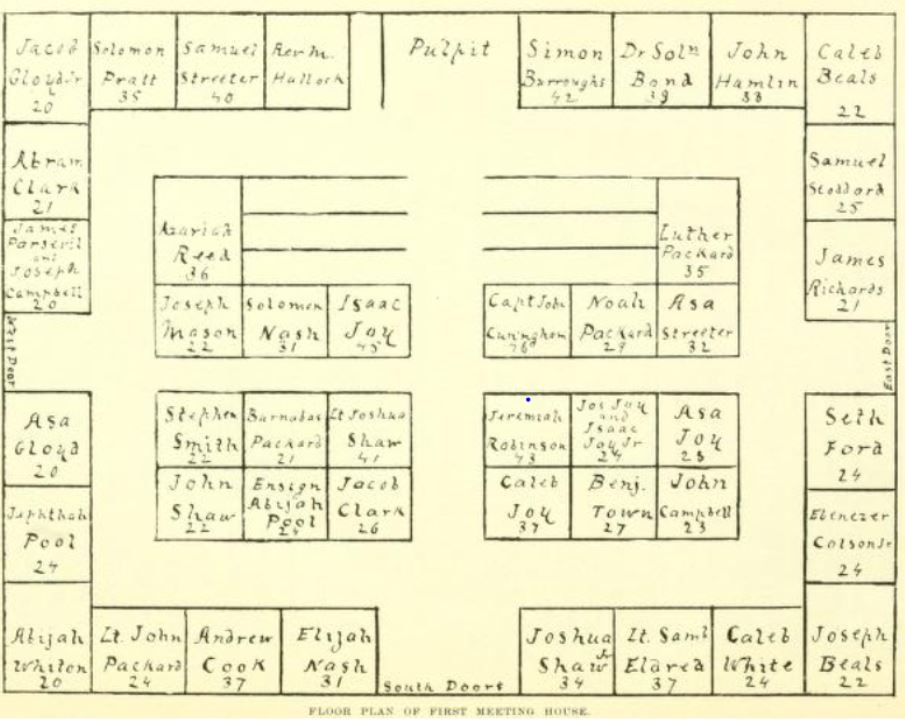
The men who bought the church pews, in addition to paying for the rum, supplied the source of funds to build the meeting house. Most of this was to be paid for by supplying labor and materials in equal parts for putting up the structure. There were 44 pews on the ground floor and a total of £1248 paid for them, not including the 19 balcony pews. Samuel Streeter committed the not inconsiderable amount of £40 for his family’s pew, more than all but a few of his fellow townspeople. More telling perhaps was the position of his pew next to Moses Hallock’s, right by the pulpit. In the next few years the minister bought land and built his home on the north side of Main Street, closer to the Upper Village. Finding his salary inadequate, however, in 1793 Moses “began to receive students into his family” and ran a well known and rigorous college preparatory school out of his home for 31 years, teaching over 300 students, including 30 girls.13
An admired pillar of his community, he remained the town’s minister for almost 40 years, dying in 1837, his passing much lamented.
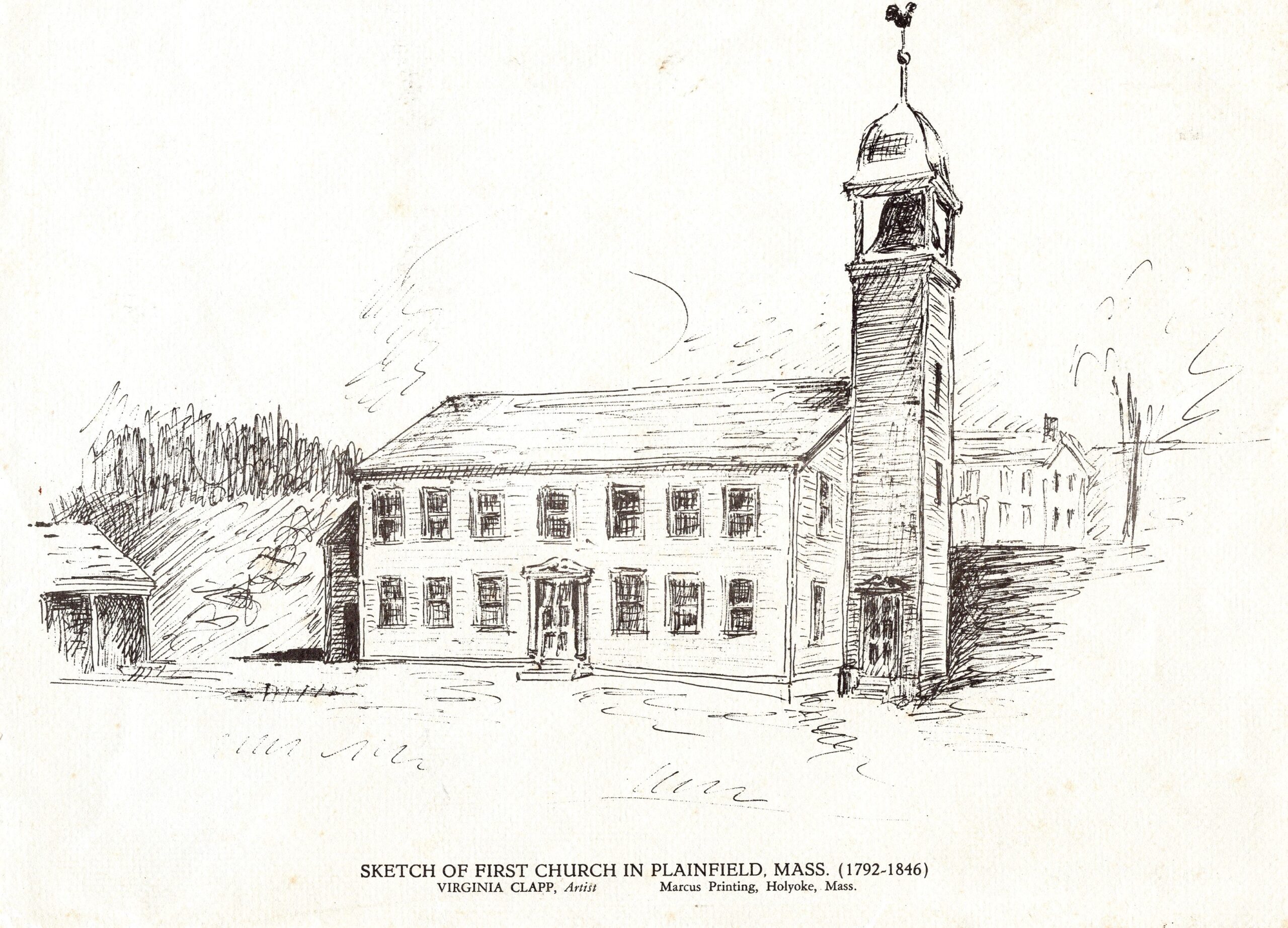
After hosting assemblies at Samuel’s house for most of the previous four years, Plainfield finally held its first town meeting in its unfinished meeting house on August 20, 1792. The short three month time period, from breaking ground and laying the “underpinnings” to this first meeting, attests to the huge communal effort of the townspeople. We are not sure how much rum was necessary to raise the frame, but work continued nonstop to enclose the structure before winter with Samuel’s mill supplying much of the materials. That spring and summer a constant sight must have been the oxcarts filled with lumber, straining up the steep road from the mill to the building site.14
For Samuel Streeter the joyful occasion of the meeting house inauguration was tempered by the death in September of his brother Daniel; we can only guess at the cause. Only 35, he left a pregnant wife and five small children. In his short life, Lieutenant Daniel Streeter had held multiple town positions including tythingman, surveyor of lumber, fence viewer 15and hogreeve.16 A saddler by trade, he was a skilled artisan whose work would have been much in demand; he was accordingly appointed a sealer of leather for several years.17 Samuel, as the oldest and most established brother, would have felt the weight of responsibility in dealing with this tragedy by taking care of his brother’s family. This couldn’t have been easy, as by this time he and Bathsheba had six children of their own, all under 12 years of age. Daniel did not leave a will, and early the next spring a notice appeared in the Hampshire Gazette announcing that commissioners of a probate court would meet at Samuel Streeter’s house for three separate sessions in 1793 to settle his brother’s accounts. Daniel is described as insolvent in this notice, but it is ambiguous, as some people apparently were also indebted to him as well. In any case, it is probable that Samuel, with perhaps some help from youngest brother Asa, paid off Daniel’s accounts which allowed his widow and children to continue living in the house that he had recently built across the street from the meeting house. Daniel’s body was buried close by in the small cemetery just south of the Lower Village.18
In February 1793, the town changed its mind and decided to pay Samuel £10 outright for the meeting house’s 1-1/2-acre lot.19 The next month Samuel was voted constable and tax collector.20 In the latter capacity he was obligated to collect 49 shillings for the town that year. Samuel was also appointed sexton to care for the meeting house and for this task was paid three shillings.
As the town had agreed to move his barn that year, Samuel was appointed, along with Caleb Joy and Andrew Cook, as part of a committee to oversee this, and they set the date of May 29. Samuel was voted $6 out of the town treasury to supply rum for the occasion. A week later the town met again with only one item on the agenda, and before the meeting “desolv’d,” the men voted to give him a further $7 to put his barn in repair and “free the district from any further cost or trouble about the matter.” What the “trouble” referred to is unclear but perhaps Samuel’s fellow townsmen were becoming frustrated with the cost and confusion of his barn relocation, in addition to all the work necessary for the completion of the meeting house.
Given his many commitments, it is not surprising that in the spring meeting of 1794 Samuel gave up, after only one year, the time consuming position of constable. At this same meeting, seven townsmen’s bills were accepted for their previous year’s work in prepping his barn and for work done on the new town bridge just above his sawmill. This long planned bridge was the first of any importance to be built in Plainfield, finally reliably connecting the more sparsely settled western end with the rest of the town. It also seems clear that Samuel’s barn bills were in excess of the $7 that he had been allotted for its relocation the year before, and his current bill of £2 19 shillings illustrates his barn’s continued cost to the town.21
Later that spring Samuel was reappointed sexton for the meeting house. For 8 shillings a year (a raise of 5 shillings from the year before) he had to sweep the aisles once a month, the seats and pews every three months. With the interior of the building approaching completion, this amount also proved inadequate and his salary was raised to $3 for the next two years. The meeting house continued to be worked on in 1795-1796, with stone steps, doors, pews, balcony and pulpit all needing to be built and installed. Due to insufficient resources, however, Plainfield had to wait a full five years from its inauguration for the meeting house to be finished and dedicated in 1797.22
With rapid settlement the road network in Plainfield was expanding quickly, especially county roads that connected neighboring towns. All men were required to contribute work for the creation and maintenance of these roads. Most chose to pay this tax with their backs as almost no one had actual currency. In 1796 Samuel was given a credit on his road tax as he had already worked above and beyond what was required of him. 23Samuel also picked up a new position, that of animal pound keeper, which he would not relinquish for another 8 years.24
Animal Pound
Wooden animal pounds that constrained stray animals appeared in New England towns as early as 1635, and a century later many were starting to be rebuilt in stone. Plainfield’s first recorded animal pound dates from 1789 and was a repurposed log cabin on Dr. Solomon Bond’s land on the southeast quadrant of the Upper Village. The first pound keeper was Simon Burroughs who lived just up the crossroads. By 1797, this “cabin” had degraded extensively and Samuel, now the pound keeper, joined Noah Packard on a committee to find a new place to rebuild it. Animal pounds were often located near the center of settlements, and perhaps not surprisingly, they found a spot on Samuel’s property down the steep hill between his mill and the meeting house. This was one of the only level spots on the hillside, and he may have donated this low value half-acre plot to the town. Voted to be built of stone, the pound was bid off to Oliver Robinson for $37; this is when the problems began. Oliver did not build the pound, for reasons perhaps relating to its high cost and the recent loss of two of his infant children. The following year, 1798, Samuel replaced him as pound keeper, and the town voted again to build a pound, but a wooden one, bid off to John Shaw for $14.75. This structure was also never built, for reasons unknown, even though its cost was less than half of a stone pound. In 1799, the town voted yet again to build a pound, this time having a 5-man committee (including Samuel) to see it through. Finally, on the third try, a wooden pound was built by Josiah Shaw for $15 on Samuel’s land, half way down the hill. As before, it took about eight years for this wooden pound to deteriorate enough for the town to vote in 1807 to rebuild it on the same spot, but this time in stone.25 This much more permanent structure was 30-ft. square and 6-ft. high, a fairly standard size and shape, built for Timothy Packard’s bid of $39.26
Why would Samuel choose the unrewarding jobs of sexton and pound keeper? Both were low status and barely remunerative, but they were close to his home. Did civic and religious duties, combined with convenience, play a part in this busy man’s decision making? Issues of religion and town governance mingled not only in church and town meeting but in the daily concerns of the townspeople. Samuel, undoubtedly religious, once again found time to be one of the town’s three tythingmen in 1797, as well as one of the eleven surveyor of highways in 1800.
Plainfield’s Heyday
The years surrounding the new century saw the town’s greatest development. After years of growing pains Plainfield was now well established with a church, three schools, numerous mills and yeoman-built cape cod houses sprouting from one end of town to the other. The first houses in Plainfield were exclusively of this design and remarkably similar with 40′ by 32′ foundations. These were commodious, full two-story structures reflecting the relative affluence of the owners. The few houses in Plainfield which survive from the 1780s are all of this size and were originally painted red.27 The next decades saw numerous more modest capes of 1-1/2 stories being built, many by the sons of the original settlers. Common throughout backcountry New England, these vernacular, federal-style farmhouses continued to be built until the Civil War period. Over 25 of these cape-style houses still stand in Plainfield.
The transportation network in western Massachusetts had improved greatly from the earliest days when the only wheeled vehicles were ox carts, and townspeople mostly traveled on foot or, if lucky enough, on horseback. By the last years of the century there was a regular stagecoach route running through the village’s Main Street passing by Samuel’s house, down the hill and continuing west. By 1798 or so Samuel, always entrepreneurial, spent $60 for his innkeeper license to take advantage of the increased traffic by his house. In that year, his wife Bathsheba, aged 42, gave birth to Nahum, their tenth and final child. One would imagine that lodgings must have been tight at the Streeter Inn with the addition of overnight guests.
By focusing on Samuel’s life, this history does not mean to minimize the contributions of his wife, Bathsheba Barton Streeter. Unfortunately, like most women of her time, she is entirely absent from town records, as only male property owners could vote and attend town meetings. Although unacknowledged, women were the emotional glue that held their families together, and in addition to joining the men working in the fields, they performed the endless tasks of a farm wife in the late 18th century. For Bathsheba, taking care of her nine surviving children as well as providing for travelers must have been daunting indeed.
Eventually, most children grow up, marry and leave home. It is significant to note that of the nine Streeter offspring, at least five left to seek their fortune out west with their spouses and children. Although Plainfield was growing quickly, it was already starting to lose a portion of its next generation. Most families were primarily farmers, and with good soil rare in the highlands and given the large size of families, young people looked increasingly to emigrate west to the less stony regions of New York and Ohio. Plainfield would continue to grow however, topping out at 984 residents in the 1830 census, but the exodus had already started before the end of the previous century.
One early exception was Samuel and Bathsheba’s fourth child, Susanna, who in 1804 married Joel Carr, a son of neighboring Ashfield. Samuel sold his son-in-law a lot just west of the meeting house on which to build their house. Within a year or two Joel had a small tannery on a rivulet just east of his house. Joel, without the water power necessary to grind the hemlock bark integral to the tanning process, relied on his father-in-law to do that chore at his sawmill, and it was then hauled up the hill to his tanning vats.28 Joel took over the position of pound keeper from Samuel for two years (1805-1806) and ran his tanning mill for about four years until 1810, selling his house during that time (1807). He may have moved with Susanna into his in-laws’ for a few years, but the small tannery wasn’t making it, and by 1810 he appears on the census of Meredith, NY, where other Plainfield families had relocated.
The Mills
Samuel and Bathsheba’s last four children were all boys, and the first and last of these, Arnold and Nahum, eventually decided to stay and become millers themselves. It appears that Samuel ran his saw mill until around 1816, and after that it was taken over by his sons. By this time Arnold was in his mid-twenties, married with three children, possibly all living with his parents. Nahum, the youngest, was still in his late teens and most probably at home as well. In 1820 the brothers built what became a substantial woolen mill on the site next to their father’s saw mill and ran them both. Producing mainly satinet, this wool mill burned down five years later but was quickly rebuilt and running again by 1826.29 Later, a cloth dressing and fulling mill was built upstream on an island in the Mill Brook just below the bridge.30 Eventually, these mills used so much wool that they outstripped the local supply and needed to import more from Albany.
Both brothers eventually built houses around 1830 on their father’s land nearby. Arnold’s was just up the hill from the mills near the pound, and was eventually expanded by his son Sereno into a mill house for women workers. For convenience, an adjacent pedestrian bridge was built crossing above the road for the workers to enter the three-and four-story mills below. Nahum’s home lay just down the hill across the Mill Brook bridge, upstream from the mills. The sawmill ran until about 1870 under what eventually became four generations of Streeters and the woolen mill until 1876, when it burned again. It was not rebuilt.
Endings
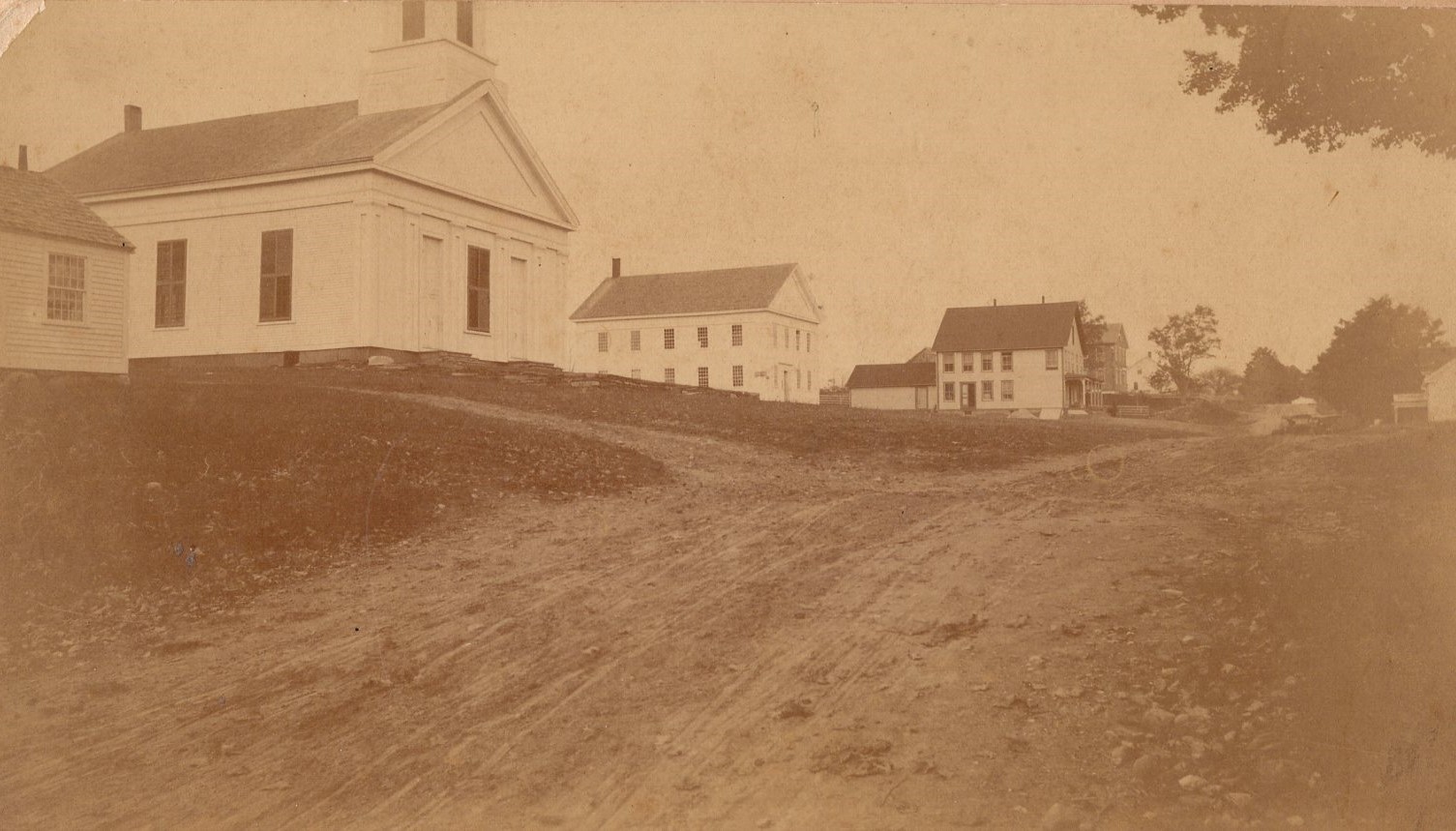
By the time he retired from running his mill Samuel was in his early 60s. Having experienced and accomplished much since the beginnings of the settlement, he was by now a respected village elder. He had witnessed the town center change from a bridle trail with two crossroads, surrounded by forest, to a fully developed, backcountry hill town. He and Bathsheba had lived through this evolution right from the center of things, their home behind the meeting house in the Lower Village.
In 17th and 18th century New England, one went to church meeting two times on Sunday, before and after the noon break. This had served to inculcate in congregants that the entire sabbath was the lords day. Listening to that amount of preaching required Yankee stamina, especially in winter as the church was unheated. As was customary, parishioners took their lunches with them to one or two nearby homes during the break. Usually this was at Samuel Streeter’s and/or the house that his brother had built across the street. In his History of Plainfield the author C.N. Dyer, writing in 1891, describes a cozy scene at these lunch breaks where in winter “most of the elderly ladies carried ‘foot stoves’ in which they placed a dish of glowing coals raked out of ‘Uncle Sam’s’ fireplace and carried them back to meeting.”31 This term of endearment perhaps carried a bit of community pride as well for the old militia leader. In 1822, when the town finally heated the church by installing stoves, Samuel would have been 68 years old; and by the time Dyer’s well-worn anecdote appeared in his history it was more than 70 years old, clearly already ancient history of bygone settler days.
Up the road, Simon Burroughs had transformed the Upper Village over the years through selling off pieces of the “common.” By the beginning of the second decade of the 19th century it had contained several stores, a blacksmith shop, gun house, law office and a tavern. Despite all this, in his early 60s, Simon sold out and moved west to Ohio with his family in 1812.32 The Lower Village, dominated by the meeting house and surrounded by its horse and carriage sheds, contained stores, a blacksmith shop, a hat shop dwelling, a school, and eventually a hotel converted from Daniel Streeter’s home on Main Street.
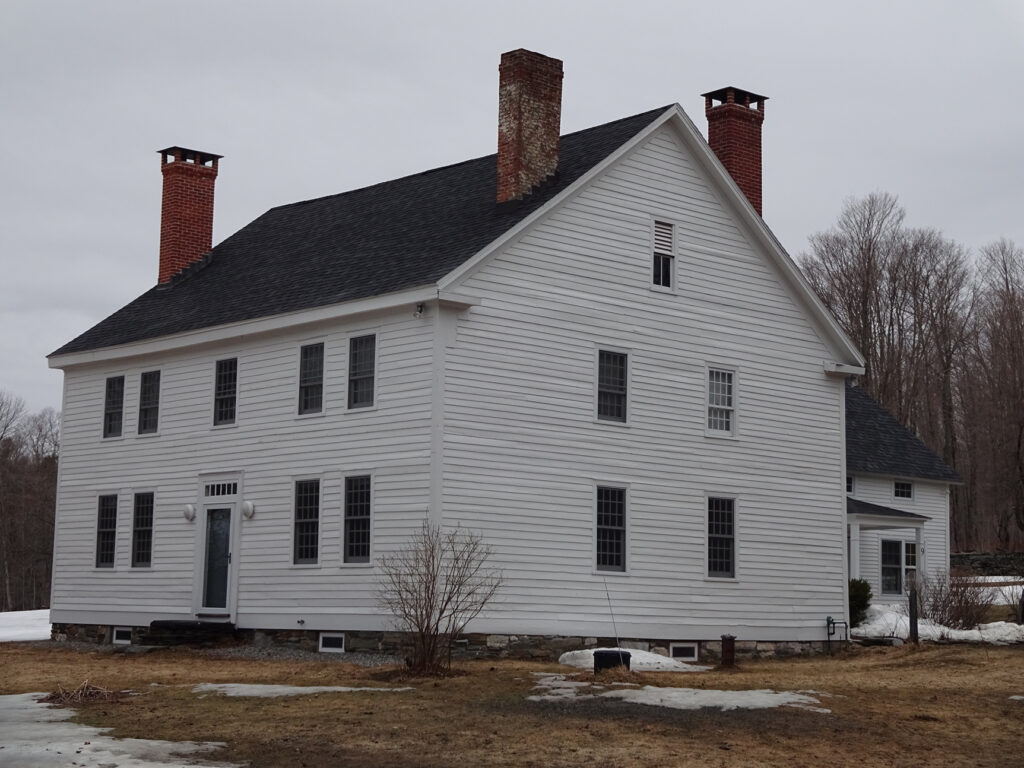
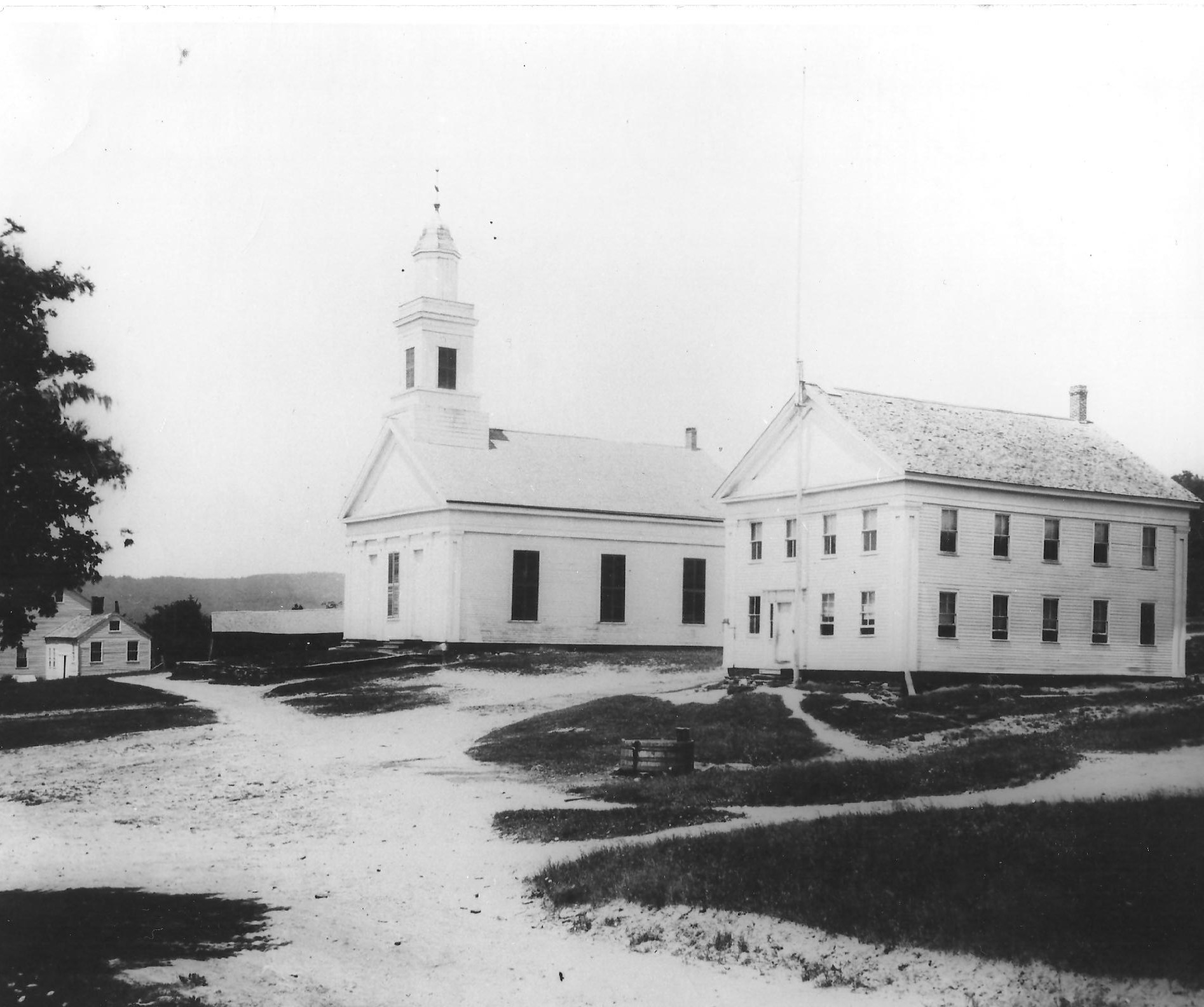
About 1830 Samuel and Bathsheba sold their home to lawyer Cyrus Joy, who doubled its size by lifting it up and putting in a new story underneath. With the added four chimneys, it became a “modern” two story colonial and all but unrecognizable. The old couple may have then moved down the hill to Arnold’s house to live out their days surrounded by his and Nahum’s families. Perhaps it was a good thing they did not live long enough to see their venerable meeting house taken down in 1845. Much debated, this decision was opposed by a minority in the town who thought it would have been cheaper to remodel the building and reuse its heavier and sturdier frame. Despite this, the town replaced the old fashioned meeting house with an architecturally harmonious, side by side Greek Revival church and town hall which continue to define the center of Plainfield to this day. These separate buildings were mandated by the state amendment of 1833 that divided church and state and were erected in 1846 and 1847. By then religious practice and architectural styles had definitely changed.
In the midst of these changes, Bathsheba died in 1838, aged 84, with Samuel following her six years later in 1844, aged 90. Her gravestone states the fact that she lived with Samuel for 60 years, showing pride in their longevity and life together. By this time they were some of the last of their generation of pioneer settlers. Now buried in the Hilltop Cemetery in a long line of gravestones with their children and grandchildren, they are just up the road from their former home. Always, and now eternally, right in the center of Plainfield.
Samuel Streeter Timeline
1754 Samuel Streeter born in Sturbridge, MA
1774-1775 “Minute Man” volunteer
1775 Revolutionary War begins
1778 Buys lot 70 in Plantation #5
1779 Marries Bathsheba Barton in Charlton, MA Buys lot 69 in Plantation #5
1780 First child Hannah is born
1780-1782 Establishes saw mill on Mill Brook
1783 Revolutionary War ends
1785 Plainfield established, separate from Cummington
1787 Signs Shays’s rebellion Oath of Allegiance Surveyor of Highways
1787-1789 Hosts most town meetings in his barn
1789 Tythingman
1790 On committee to build school in District #1
1790 On committee to build a bridge above his mill
1790-1791 Samuel hosts town meetings in his house
1791 Town votes to place the meeting house on Samuel’s land and hold subsequent Sunday meetings at his house
1792 On committee to settle the meeting house site First town meeting in unfinished meeting house Samuel pays £40 for his pew Samuel’s younger brother Lt. Daniel Streeter dies, age 36
1793 Town votes to pay £10 to Samuel for meeting house lot Samuel hosts probate court three days to settle Daniel’s debts On committee to move his barn
1793 Constable Town helps Samuel move his barn
1793-1796 Sexton of meeting house
1794 Bridge built above his mill
1796 Tythingman
1796-1803 Poundkeeper
1797+1799 On Committee to decide pound site
1797 Last child Nahum is born
1797 Samuel purchases innkeeper license
1800 Surveyor of Highways
1804 Sells lot next to meeting house to son-in-law Joel Carr
1807 Stone pound built
1816 Samuel retires and Arnold and Nahum take over their father’s saw mill
1820 Arnold and Nahum build woolen mill next to the saw mill
1825 Woolen mill burns and is rebuilt in 1826, runs until 1876
1830 Samuel sells his home to Cyrus Joy, who rebuilds it
1838 Samuel’s wife Bathsheba dies, age 84
1844 Samuel dies, age 90
Acknowledgements
All historians’ work stands on the shoulders of their predecessors, and I am no exception. This short history would not have not been possible without the following:
Only One Cummington, Volume 1, 1974 Helen Foster and William Streeter
Only One Cummington, Volume 2, 2008 William Streeter and Alan Berrian
History of Plainfield, 1891, C.N. Dyer
The Hampshire History, 1964, Plainfield chapter by Thomas Packard
To Priscilla and Arvilla Dyer for their decades of deed research, illustrations, maps and field research which supplied voluminous material about the early history of Plainfield
- Being a member of the militia was obligatory for men age 16 to 60, they would train occasionally. Minute men were formed during the run-up to the Revolutionary War, (1774-1775) and were a voluntary force of men under 30 who trained weekly and could respond in a “minutes time” to any alarms. Samuel undoubtedly answered these calls both before and after moving to Plainfield. ↩︎
- Often these first framed house were built later when yeomen had more time and resources. The ell attached to Samuel Streeter’s house is indeed 18’wide. ↩︎
- Around 1800, Mrs. Polly White, 18, attempting to visit her neighbor Bathsheba Streeter, became lost following blazed trees in the woods. Only the sound of Bathsheba’s dinner bell finally guided her out of the forest and to the dinner table. ↩︎
- Cummington is a good example of this “miasma theory” as its first houses and two meeting houses were located at the tops of hills. It was only around 1800 when these health fears subsided that the center of the town began to develop along the south side of the Westfield River. ↩︎
- The Hatfield Equivalent was a large grant of land given in 1744 to compensate Hatfield inhabitants for their riverside land that had been incorporated into other towns. It took many years to sort out the ensuing land conflicts. ↩︎
- His mill is first mentioned in a town meeting road acceptance vote in 1783. ↩︎
- In census forms from the middle of the 19th century, both of Samuel Streeter’s sons, although mill owners, described themselves as farmers as well. ↩︎
- A Surveyor of Highways was responsible for the construction, maintenance and repair of roads, as well as surveying and mapping the routes. ↩︎
- Tythingmen maintained order in church and collected tythes; usually two or three men were chosen. Their duties were varied, ranging from collecting church taxes to detaining people on the roads on Sunday who were not traveling to church. In the spring 1796 town meeting citizens “voted that the district provide three wands for the Tythingmen.” These long, tipped wooden staves were badges of office, used to wake sleeping parishioners, discipline children and keep order in the church. ↩︎
- Colonial gun houses were buildings used to safely store weapons and ammunition. Plainfield had two distinct gun houses over the years. The second one was large enough to store full- sized cannons and was located down the street in the Lower Village. When it was decommissioned around 1860 it was moved back to the common, very close to the spot of the original, and modified into a home. It is still known as the gun house today. ↩︎
- Poll taxes were assessed on every male above 16 years of age. ↩︎
- The term corn mill was used interchangeably with grist mill, particularly if corn was the most common crop. Both described facilities where grain was ground into meal or flour. ↩︎
- His school graduated 50 students who became ministers and seven who became foreign missionaries. Notable attendees included Marcus Whitman, William Cullen Bryant and John Brown. ↩︎
- A surveyor of lumber was responsible for measuring, inspecting and grading wood products. ↩︎
- A fence viewer, upon request, would inspect stone or wooden boundary fences and settle disputes concerning straying livestock. ↩︎
- A hogreeve was entrusted with preventing and appraising damage by stray hogs. They would ensure that all hogs were yoked and had a nose ring to prevent rooting and burrowing. Hogs were generally not allowed to run freely in Plainfield. ↩︎
- A sealer of leather would inspect and verify the quality of leather products. ↩︎
- On a macabre note, Daniel’s namesake and youngest child hung himself in 1855, aged 62. All four of his children had died in infancy and his wife in childbirth at age 28. Not unexpectedly, the newspaper notice of his death described him as insane and being a rum and opium addict. He was the last person buried in the cemetery that contains the body of his father. Because of the nature of his death he was probably intentionally interred there, in this all but abandoned yard, far from the rest of his family in Hilltop Cemetery. ↩︎
- In 2015 the Plainfield Congregational Church had to pay the town $25,000.00 for the church lot in order to build an addition. Up to that point the church did not own the land because in 1792, before the separation of church and state, Samuel had sold the meeting house lot to the town. ↩︎
- The constable kept the peace and maintained order in the community. He would also levy and collect all fines and execute all town warrants. ↩︎
- Dollars and pounds were used simultaneously due to a severe shortage of British currency, forcing reliance on foreign, widely circulated Spanish dollars. Dollars were used for daily transactions while the British pound was maintained as a formal unit of account for trade, debts and taxes. ↩︎
- The bell tower wasn’t added until 1800. ↩︎
- In Plainfield, the tradition of manual roadwork in lieu of taxes lasted well into the 20th century. ↩︎
- A pound keeper would seize, secure and care for stray livestock in the animal pound. A fine, payable to the pound keeper, had to be paid in order to release one’s animals. ↩︎
- Coincidentally, Cummington also built their stone animal pound in 1807. One of only about 100 or so to survive to the present time, it is located on Potash Hill road, just below the site of Cummington’s second meeting house. ↩︎
- Animal pounds needed to be “horse high, bull strong and hog tight”. As of 2026, Plainfield’s Historical Commission has plans to completely rebuild the animal pound in the coming years. ↩︎
- The iron oxide in this paint gave it its color and served as a protective sealant against rot. ↩︎
- At the site of Streeter’s sawmill, stacked in the middle of a stone pier are repurposed, smooth, circular, bark millstones. ↩︎
- Satinet mills were prominent in New England from about 1820-1870. They manufactured an inexpensive durable fabric with a cotton warp and wool weft used for work clothing and Civil War uniforms. ↩︎
- A cloth dressing and fulling mill would clean, thicken and raise the fibers of woolen cloth to increase density, strength and softness. ↩︎
- The iconic image of Uncle Sam was based on meatpacker Samuel Wilson, who during the War of 1812 stamped his ration boxes “U.S.” ↩︎
- Shortly after this, C.N. Dyer relates in his Plainfield history that Burroughs’s house “was torn down one night by some citizens to prevent its occupancy by a Negro family that were about to move into it,” an unusual and unflattering inclusion from a local historian. ↩︎