Memories of Dr. Samuel Shaw Through the Eyes of His Granddaughter, Ms. Clara Elizabeth Hudson
The following are excerpts from The Romances of a Country Doctor, a paper read at the annual meeting of the Northampton Historical Society at the Unitarian Church, Northampton, on October 7, 1947 and Plain Tales from Plainfield or The Way Things Used to Be, 1962, both by Clara Elizabeth Hudson. Ms. Hudson was a granddaughter of Dr. Samuel Shaw and the last surviving relative to live in the Shaw Hudson House.
Click on photographs to enlarge. All blue text are hyperlinks to more information.

Dr. Samuel Shaw
“In giving you this story of the romances of my maternal grandfather, Dr. Samuel Shaw of Plainfield, I want to confess that practically all of my material is derived from an account written by my uncle, Mr. Charles Lyman Shaw, nearly half a century ago. And, while I shall tell you of Dr. Shaw’s two love-affairs, other events in this life of a bygone era can surely be properly termed romantic.
Samuel Shaw was born May 6, 1790, at Abington, Massachusetts, about twenty miles from Boston. When he was nearly two years old his father moved to Plainfield. The family made the long journey from the coast in February, 1792, travelling in a covered sleigh. Emerging from the damp forest which covered Bear Mountain and filled the valley of Swift River, they were met and welcomed by their good kinsman, Deacon Richards, who brought them a luncheon prepared by his skillful wife. The tired and hungry child remembered with delight until old age the surpassing flavor of the doughnuts sent by his Aunt Lydia. Reaching at length their farm in the southeast part of the township, the immigrants found temporary shelter in a rude cabin until a frame house could be built.
Samuel’s boyhood was spent on his father’s farm, which, besides mowing and pasture land, usually contained five acres of flax, five of com, two of wheat, and as many of rye. The flax was pulled about the first of August. To pull one-quarter of an acre was thought to be a good day’s work, but the boy Samuel often exerted his extraordinary strength and astonished his father by doing the work of two men.

While he was at work hoeing corn in 1806 he saw the memorable eclipse of the sun.

In the autumn of 1807 he was dangerously ill with typhoid fever; in the following autumn he had a second attack, caused, Dr. Bryant thought, by excessive labor. The young man then resolved to fit himself for a profession. He bought his time from his father, and in the winter of 1809-10 he spent seven weeks with Parson Moses Hallock in Plainfield, studying grammar; the next winter he studied arithmetic with a Mr. Bassett. During both seasons he was a clerk in Mack’s store in Plainfield. At this time he saw much of ]onas King, later a missionary to Greece. The stupidity of this fellow clerk astonished Samuel, who saw in the plodder no signs of future greatness.
Hard work and a simple diet made the young student athletic. He liked to try his strength in wrestling matches and he performed many wonderful feats. In later years he delighted to tell his children that he had lifted an iron shaft weighing 952 pounds; that he had raised and held at arm’s length two iron weights of 56 pounds each; that he had jumped over a cord held by two persons at the height of his head, 5 feet, 10 inches; that he had carried a barrel of flour from the road to his cottage; that he once lifted a barrel of cider, carried it some distance, put it into a cart,
and then unloaded it while his father looked on in astonishment; and that at the age of twenty-five he jumped eleven feet, clearing ten.
In order to acquire the means needed for the prosecution of his medical studies, he taught school six successive winters, from 1811until 1817. He began his labors as schoolmaster in Windsor, Massachusetts, where he received $11.00 a month; the next two winters he taught in Plainfield, receiving $12.00 a month; he then gave to Ashfield the benefit of his instructions which were so esteemed that his wages were raised the second season from $15.00
to $18.00 a month; in 1817 he taught his last school on the heights of Peru, Massachusetts. Intervals of leisure during these years he devoted to study.
In 1813 he spent some time at Parson Hallock’s school in Plainfield in order to acquire some knowledge of Latin and Greek. The freshman class at Williams College was composed largely of graduates from this school.
In the following year Samuel Shaw began the study of medicine with Dr. Peter Bryant of Cummington. The summer of 1817 he spent at the Bryant Homestead, studying and visiting patients with the doctor whose poet-son, William Cullen, shared with Samuel the garret as sleeping quarters. Samuel rapidly became so skillful in the treatment of diseases
that Dr. Bryant did not hesitate the following winter to leave the sick people of Cummington under the student’s care during his own absence in the Massachusetts Senate.
In 1818 Dr. Shaw entered into a partnership with Dr. Bryant which, however, lasted less than two years. Dr. Bryant later left his medical library to his former pupil.


Two subsequent winters, 1819-20 and 1820-21, Dr. Shaw spent in Boston, attending medical lectures. Because of his medical talents he was treated with great attention by two professors, Dr. Warren and Dr. Jackson, and was invited by several families to settle in Boston.
Cummington Hill, however, had greater attractions. His life there had not been wholly devoted to the study and practice of medicine. In the society of Dr. Bryant’s lovely daughter, Sarah, he had often found greater pleasure even than in that of her poetical and philosophical father, and of her brother, William Cullen, whom our family thought, “a bear.” In some delightful ramble by the “Rivulet,” through the wood, or up the heights of Remington Mountain, Samuel doubtless told his love and leaned that he had found favor in Sarah’s eyes. They were married September 13, 1821. This union was blessed by only one child, a daughter named Ellen Theresa, who was born at the Bryant Homestead on October 24,1822.
For several years the people of Plainfield had been begging Dr. Shaw to become their physician. In 1824 he yielded to their entreaties and, removing to that village, occupied the house known later for many years as the Winslow Cottage. Here his life was soon saddened by the loss of his beloved wife, who died on December 12, 1824. I have always been told that she went to the Bryant Homestead to visit, slept in damp sheets and developed “galloping consumption.” Sarah Bryant Shaw was buried in the Shaw family lot in Plainfield cemetery and her tombstone bears the epitaph: ‘Farewell, Sarah, no rolling sun, Shall e’er to me thy life restore. In vain below I seek to find, Thy many virtues, now no more.'”

In her memory William Cullen Bryant wrote the poem, “The Death of the Flowers,” beginning,
The melancholy days are come, the saddest of the year,
Of wailing winds, and naked woods, and meadows brown and sear.
Heaped in the hollows of the grove, the withered leaves lie dead;
They rustle to the eddying gust, and to the rabbit’s tread.
The robin and the wren are flown, and from the shrubs the jay,
And from the wood-top calls the crow, through all the gloomy day,
Where are the flowers, the fair young flowers, that lately sprang and stood
In brighter light and softer airs, a beauteous sisterhood?
Alas! they all are in their graves, the gentle race of flowers
Are lying in their lowly beds, with the fair and good of ours.
The rain is falling where they lie, but the cold November rain,
Calls not, from out the gloomy earth, the lovely ones again.
The wind-flower and the violet, they perished long ago,
And the brier-rose and the orchis died amid the summer glow;
But on the hill the golden-rod, and the aster in the wood,
And the yellow sun-flower by the brook in autumn beauty stood,
Till fell the frost from the clear cold heaven, as falls the plague on men,
And the brightness of their smile was gone, from upland, glade, and glen.
And now, when comes the calm mild day, as still such days will come,
To call the squirrel and the bee from out their winter home;
When the sound of dropping nuts is heard, though all the trees are still,
And twinkle in the smoky light the waters of the rill,
The south wind searches for the flowers whose fragrance late he bore,
And sighs to find them in the wood and by the stream no more.
And then I think of one who in her youthful beauty died,
The fair, meek blossom that grew up and faded by my side:
In the cold moist earth we laid her, when the forest cast the leaf,
And we wept that one so lovely should have a life so brief:
Yet not unmeet it was that one, like that young friend of ours,
So gentle and so beautiful, should perish with the flowers.
“For six years Dr. Shaw lived a widower, cheered occasionally by the efficient housekeeper, Annie Joy. His sorrowful life before long excited the sympathy of his friend, Dr. Joseph H. Flint of Northampton, who, in 1830, advised Dr. Shaw to marry again, recommending, as a suitable companion, a young lady of Pleasant Street ~ the lovely and accomplished Elizabeth Owen Clarke.

This young lady, after receiving a good education, had spent several years at the South engaged in teaching. She also had given important aid in the preparation of a series of historical charts to her sister, Anne Laura Clarke, said to be the first woman historical lecturer in the United States. In 1824 she was in Philadelphia and was present at the reception given to General Lafayette. The death of her brother, Joseph Hawley Clarke, in November, 1825, called her home. Here she was occupied with the care and education of his orphaned children, when in 1830 she met Dr. Samuel Shaw. In the letter in which Dr. Flint urged Dr. Shaw to make her acquaintance, that encouraging friend wrote: “You have the recommendation of easy circumstances, good professional business, an enviable standing in your own neighborhood, and are neither so rude nor unpolished nor so ignorant nor old nor wrinkled but that a sensible woman might even love you as a wife should her husband.” Dr. Flint further gave this alluring description of her character and charm: Elizabeth Clarke is the daughter of Joseph Clarke who was adopted and educated by Major Hawley [his uncle-in-law] and inherited his estate. She is sister to Anne Clarke, the historical lecturess, a woman of rather extraordinary powers of mind and of very considerable literary acquirement. She is now delivering a course of lectures in Boston. Elizabeth, the younger sister, is about twenty-three, rather below ordinary size, a good form and not fat. She has a good complexion, brilliant black eyes and shows as fine a set of teeth as you ever b’eheld. She has been associated with her sister in teaching the young idea how to shoot and is quite proficient in the accomplishments deemed so important in female education, such as music, painting, etc. etc. Her parents are dead. Her mother was said to have been a most estimable woman in every relation and Elizabeth is said to bear her resemblance. She has spirit and independence and has not the least thought of truckling to anyone. But from long and intimate acquaintance and under circumstances, too, when she could not dissemble, I know her temper is sweet and amiable and that she preserves her spirits and good humor under all circumstances. This is saying a great deal, Doctor, of any lady; but I aver it is the truth and nothing but the truth.
Dr. Flint’s invitation and description proved irresistible; for Dr. Shaw came, saw, and soon won the accomplished Elizabeth.
To quiet any fear that the elder sister on her return home would be able to break the engagement, Dr. Flint wrote in June: But I know better. Elizabeth Clarke is not in leading strings; mild and pleasant as she always is, she has, nevertheless, decision of character and will never be dissuaded from purposes of which her judgement approves. I think you are a lucky dog.”
This skillful matchmaker saw his scheme crowned with success on October 16, 1830 when the handsome doctor carried away the lovely Elizabeth to his mountain home.

In 1833 he built the large house which is still in the possession of his descendants. Elizabeth’s friends told each other that she had “gone up to live in a great big barn of a house.” Very possibly the thirteen-room house was at first not overstocked with furniture. From the grounds adjacent, “glimpses may be obtained of a beautiful landscape in which hill rises beyond hill in successive ridges until Blandford Church and Sweetman Mountain seem with other distant points to meet the southern sky.”
For forty years Dr. Shaw was a member of the Massachusetts Medical Society. Twenty years after his death his opinions were still quoted in the Society. His cheerful disposition, intuitive judgment, and great skill made him a popular and successful physician. During one epidemic he did not have his clothes off for an entire week. When a man once said to him, You’re a rich man, Dr. Shaw,” his reply was: “It takes all that I earn in the daytime to support my family. Whatever I have been able to lay up I have earned while other men slept.”
He continued in active practice until 1854. One evening in September of that year he was hastily summoned to West Cummington to attend his married daughter, Ellen. On the steep road that leads from West Hill to the Westfield Valley the horse took fright and he was thrown from the carriage with such violence that he received injuries from which he never recovered, though he lived on for sixteen years.
Grandfather Shaw’s medical office in Plainfield was a most unusual room. It was papered in deep red, and its window shades were a deep brown with a gold stripe near the outer edges on the side facing outdoors. One of its three doors led into the house proper. Behind the office was a small bedroom where the doctor could sleep when be came in very late from an emergency call, so as not to awaken the family. The third door led outdoors. On its inner side the red paint had been applied in imitation Of the grain of natural wood – a lost art, it is said. This third door was a duplicate of the other front door, which opened into a long hall running the length of the house, thus ensuring fine ventilation.“


Dr. Samuel Shaw’s custom-made “Windsor” chair. ca 1935. Property of Shaw-Hudson House Collections. Photo courtesy of William Hosley
“The furniture in the office was mostly Windsor-style, painted black. The most interesting piece of furniture was a large writing arm Windsor chair, especially made by an excellent local carpenter to accommodate the doctor’s ample proportions.
During his long practice he bad many stirring adventures and narrow escapes. Once when he was driving through a wood in a thunderstorm a blinding flash of lightning struck his gig, rendering him for some time unconscious. Many times he forded the Westfield River when the bridges had been carried away by freshets; sometimes, swept far downstream by huge cakes of floating ice, horse and rider barely escaped destruction in the whirling torrent.
Once, while riding on horseback along a lonely road, he was startled by the sudden appearance of two horsemen who rode out from behind a clump of bushes. For some distance they rode in silence on each side of him, quickening their pace whenever he tried to leave them behind. Expecting every moment to be attacked, the doctor was surprised and relieved when the mysterious horsemen turned into a thicket and disappeared. Often, braving winter storms, he had to dig a way for his horse through deep snowdrifts; sometimes, drowsy with fatigue and cold, he would wrap himself in the warm buffalo robes and, giving loose rein to his horse, would sink into a deep slumber, fortunately to be awakened by the sudden stopping of his sleigh under his own shed.
Dr. Shaw enjoyed sufficient popularity among his townsmen to be chosen selectman eight times. He was first elected to this office in 1826. He united with other leading townsmen in building a new church in 1846.“
Miss Hudson remembers her grandfather as one who always had a good story to tell and liked a joke. “His jolly ” Haw, haw, haw,” rings in my ears yet. One little episode I will relate. A near neighbor had several large boys who were inclined to be unruly. The neighbor was a rather quick tempered man, and one morning, one of his boys having provoked him in some way, he gave him a sounding box on the ear, the doctor being an unseen witness. The boy moaned greatly, and carried his head to one side, pretending that he could not lift it to its normal position. The doctor watching the boy occasionally through the day from his office window, noticed that when his father was out of sight, his head resumed its natural position. If his father appeared, his neck was at once bent as before. Toward evening, the father, becoming somewhat alarmed, visited the doctor in company with his son, whose head still hung on one side. ” Doctor,” said the neighbor, ” I am a little hasty, and when I gave the boy a cuff this morning, I suppose I gave him a harder blow than I intended, and he don’t seem to be able to straighten his neck since. Now what treatment would you advise?” “Well,” said the doctor, deliberately, drawing down the corners of his eyebrows, In my opinion, the best thing you can do, would be to hit him a thundering crack on the other ear.” The boy did not wait to have his father follow this advice, but at once made off with head erect!
He continued in active practice until 1854. One evening in September of that year, he was hastily summoned to West Cummington to attend to his married daughter, Ellen. On the steep road that leads from West Hill to the Westfield Valley his horse took fright and he was thrown from his carriage with such violence that he received injuries from which he never recovered, though he lived for another sixteen years. He was able however to occasionally visit patients for some years after, but always with someone to drive his horse.

Samuel and Elizabeth Shaw had six children, four daughters and two sons. Of these my mother, Laura A. Shaw, (Clara Elizabeth Hudson’s mother) was the youngest. All six survived the diseases of childhood except their oldest daughter, Sarah Elizabeth, who died of croup September 26, 1834.
During his declining years Dr. Shaw received the best of care from his wife and daughters. His devoted wife Elizabeth died of pneumonia September 27, 1863. He lived to see his eightieth birthday, but on September 24, 1870 he too passed away.“
Dr. Shaw’s family was certainly “connected” to the movers and shakers of the times. A write-up in the The Magazine of American History with Notes and Queries, Volume 17 states, “In 1830 Dr. Shaw married a second time, the lady being Elizabeth Owen Clarke from Northampton a direct descendant of Hon. Daniel Clarke of Windsor, Connecticut, one of the six patentees of that ancient town whose second wife was Mrs. Martha Pitkin Wolcott, renowned in history as the widow of Simon Wolcott and mother of Governor Roger Wolcott, as well as the grandmother of Governor Matthew Griswold and great grandmother of Governor Roger Griswold.
Dr. Shaw’s eldest son, Samuel Francis Shaw, studied medicine and as a surgeon in the navy for more than twenty years. Prior to his death won high rank in his profession and Dr. Shaw’s youngest daughter married the New York physician Dr. Darwin E Hudson.
One of Dr. Samuel Shaw’s three brothers also entered the medical profession and became a prominent physician in Barre, New York. “It runs in the family to be doctors just as it does in some other families to be ministers said one of the oracles of the town.” The two remaining brothers of Dr. Shaw settled in Plainfield and were among its most intelligent and respected citizens. One of the daughters of Josiah Shaw, the elder brother, is the wife of Judge Sawyer now in Congress from Albion, New York.”
C.N Dyer in his book, History of the Town of Plainfield, Hampshire County, Mass: From Its Settlement to 1891, Including a Genealogical History of Twenty Three of the Original Settlers and Their Descendants, with Anecdotes and Sketches writes of Dr. Shaw’s father,
“Josiah Shaw settled in Plainfield in 1792. He was then an energetic young man of twenty-nine years. He had previously prospected and purchased a tract of land, and in February of that year, he with his wife and three young children made the journey from Abington. He served in the Revolutionary army and is said to have carried a musket and fought at the battle of Bunker Hill, and to have been a sergeant at Saratoga and witnessed the surrender of Burgoyne; died Aug. 26, 1844, aged eighty-one. Children: Josiah, Jr. born in Abington, Nov 13, 1785; Samuel, also born in Abington, May 6, 1790; Nancy, Feb. 4, 1794; Dana, April 10, 1798; Freeman, Feb. 23, 1803”
Dr. Samuel Shaw’s sister, Lydia Shaw, married Deacon James Richards, one of the first settlers of Plainfield. Their son, William Richards (1793-1847), became an important missionary to the islands of Hawaii, even serving as government translator to king Kamehameha III. Today there is a street in Honolulu named in his honor.
Lydia Richards Snell (1782-1846) was the eldest of nine children born to James and Lydia Richards. Throughout most of her life she corresponded with her friend, Charity Bryant, brother of the poet, William Cullen Bryant. The Sheldon Museum in Middlebury, Vermont, houses a collection of over 400 letters written to and by Miss Charity Bryant between 1798 and 1851. Over 180 of these letters were written by Lydia Richards Snell. Historian William Hosley has written an extensive essay on these correspondences, entitled The Richards-Bryant Correspondence 1798 -1851.
Dr. Shaw died on September 24, 1870, at the age of eighty and is buried in the Hilltop Cemetery in Plainfield, Massachusetts, just a five minute walk up the road from the Shaw-Hudson House.
To learn more about the Shaw-Hudson House and to watch a video on the history of the house click here.
Gallery of Photographs of Dr. Samuel Shaw
All photographs the property of the Shaw Hudson House collections

Dr. Samuel Shaw 
Dr. Samuel Shaw 
Dr. Samuel Shaw 
Dr. Shaw’s horse


William Cullen Bryant 1794 – 1878
The small hilltowns of Plainfield and Cummington, Massachusetts are lucky to have not one but two historically important homes , both within a few miles of each other – the Shaw/Hudson House and the Bryant Homestead, childhood home of the famous American poet, William Cullen Bryant..
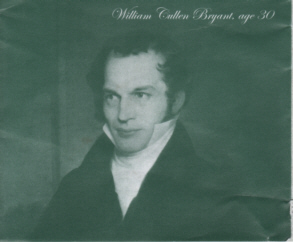
The following is an excerpt from the Town of Cummington, Massachusetts’ web site: William Cullen Bryant, born November 3, 1794, astonished the literary world with the publication of his first major poem at age 13. Most of his poetry drew inspiration from the Cummington countryside surrounding the Homestead. In 1817, “Thanatopsis,” Bryant’s most famous poem, was published while he practiced law in Great Barrington MA. After his marriage to Frances Fairchild, the family moved to New York City in 1825 where the poet and former lawyer began a career as editor; first at literary publications and eventually as editor-in-chief and publisher at the New York Evening Post. He held this position for the rest of his life. In 1834 Bryant embarked on the first of many lengthy trips, traveling widely in the U.S. and taking seven trips abroad. Many of his exotic travel mementos are now at the Homestead. Famous as a publisher and editor; Bryant’s public life involved him on many fronts as a politician and conservationist, leading to the creation of New York City’s Central Park. Artists of the Hudson River School considered Bryant their muse. At his death in 1878, Bryant was an iconic figure. His fame was so widespread that the centennial of his birth in 1894 drew thousands of people to the Homestead to celebrate his life and accomplishments.

Located on a hillside overlooking the Westfield River Valley, the Homestead is on the site of the original Cummington community founded in 1762. The Town Meetinghouse was constructed near what is now the five-corner intersection of the Homestead in 1782. Seven years later it was moved and a schoolhouse, which Bryant attended, was erected on the site. Cummington’s center shifted to the valley and as the community grew, Bryant’s father; Dr. Peter Bryant, served as physician and in the state legislature. Cummington’s population diminished after 1840, since many townspeople, like Bryant’s family, abandoned their farms and moved westward. As Bryant observed “the soil is now exhausted; the fields…are turned into pastures…and the land which once sufficed for two farms now barely answers for one.” Woodlands, a source of fuel and building materials, were also depleted. In 1865, 30 years after the Homestead was sold out of the family, Bryant purchased his former boyhood home and used it as a summer retreat from late July through early September for the remainder of his life. Year-round the house was occupied by a series of caretakers and their families. Bryant remained deeply committed to his childhood community and made a number of significant contributions to Cummington. He donated $500 to build a new schoolhouse located near the Homestead. A larger gift was a library, complete with book collection and a librarian’s residence. These two structures remain on the south intersection of Routes 9 and 112. To make access easier to the Library from the Homestead, Bryant paid for a road that later became part of Route 112. He also built a road to West Cummington from the Homestead that is still in use today.