By Priscilla C. Allen and Arvilla L. Dyer

In the beginning there were beech, pines and maples, low hills and a valley and higher hills under skies, cloudy or blue. The wild creatures had it to themselves. But in the eastern part of the state the populations were ever growing and there had to be more room for towns. So the legislature laid out ten townships in the western part of the state-they were supposed to be six miles on a side-and sold them at auctions in Boston to the highest bidder.
John Cumming bought one of them, Plantation No.5. He got other interested men together, and they set about finding settlers to whom they could sell homesteads. In order for the area to become a legal town the state had specified certain things.
Within five years there should be 60 settlers, with a learned Protestant minister settled, and provisions made for schools. The settlers’ houses should be at least 18′ x 24′ with a 7 foot stud,determining the wall height, and also 7 acres of cleared land under cultivation. With the land heavily forested, that was a large order, but there were many ready to take it up.
Land must also be surveyed and marked so a man would know what he was buying. But when Plantation No. 5 was surveyed it was found to include three other grants of land, and that was a hindrance to early settlement. But the pioneer spirit can accomplish much. In 1765 there were seven men already settled in the area, and the number grew slowly at first and then more quickly.
The early part of Plainfield history is the same as Cummington’s because Plainfield was the northeastern part of Cummington. As the town grew, the Westfield River, which flowed through northwesterly to southeasterly, was a great deterrent for getting together. A bridge was built across it in what is the western part, but as the Meetinghouse was on “the Hill” in Cummington it was a chore for Plainfield settlers to come down from Plainfield, cross the Westfield, however they could, and climb the Hill, both for Church services on Sunday and for the many town meetings necessary in the beginning years; but only the men had to worry about the last.
Because of the difficulty presented by the river, people of the northern part of the township decided to break off and found their own town, thus bypassing the big problem. So the township was divided in half, the north part becoming the District of Plainfield. It could not become a town because of lack of area, lack of 60 settlers, and most important, lack of a settled “learned Protestant minister.” But a district appears to have been different from a town governmentally because it could not be represented in the General Court, and had to join a bonafide town (Cummington) to secure that representation.
The dividing line passed through the corner point of the largest of the grants of land, Hatfield Equivalent, that had previously been made in the area. This division effectively solved Cummington’s problem with the previous grants, so it was satisfactory.
The first land grant had been to Rev. Experience Mayhew of Martha’s Vineyard as a practical compensation for his missionary work among the Indians at Gay Head on that island. No one expected he would settle here, but he could sell the 600 acres of his grant, and thus receive payment. The land was in the northeast corner of the original township.
South of this grant was a second one of the same size which was given to Governor Barnard to compensate him for service to the Commonwealth.
The third so-called grant was a great deal larger than the first two together. It was given to the town of Hatfield to compensate the inhabitants for riverside land they owned which had been incorporated into other towns. This grant has been twice moved and because it was of poorer land the amount was doubled each time making a final total of 8,064 acres.
This, to use the best land available, was laid out west and north of the two previous grants making a uniquely shaped piece. It was a rectangle, along the west side of Mayhew and Barnard’s grants, capped by a triangle extending from the west side of the rectangle across the top of Mayhew’s grant to Ashfield, which was already settled, at least in part. It was carefully laid out and measured, each inhabitant of Hatfield in 1744 getting two lots apportioned to their estate in that year. The lots were 200 rods long, laid in four tiers and two sections, and their widths were very meticulously measured in rods,feet and inches. It appears that the lots were laid out exactly by compass points’ due North and South. When Cummington was laid out it was some 19 or 20 degrees out of true north and south so that it extended to the north on each side of the Hatfield land which was called Hatfield Equivalent in all deed thereof for many years, It was a good designation to use and preserves the continuity of land purchases.
Cummington, or No. 5, has a Second Division on the east and a Third Division on the west. The lots in the west were one hundred acre lots except, where they abutted the lots of Hatfield Equivalent, and then they were of course less, sometimes much less. The lots to the east and southeast were 90 acres, and the ones in the east were not laid out with right angles because of the slant of the Hatfield Equivalent lots, though those along the south border of the District could have square corners again.
The division from Cummington gave Plainfield 3/4 of its present land. To have enough land and population to make a town something else must be done. This was solved by the state adding to Plainfield a 1 mile in a width strip from the southern part of Hawley. Plainfield’s gain was surely Hawley’s loss, for this mile includes a small village and the only lakes and ponds that Plainfield possesses that was not man-made for industrial purposes. It wracked the good start that Hawley had as a town, making its inhabited territory “the edge of Hawley” ever since.
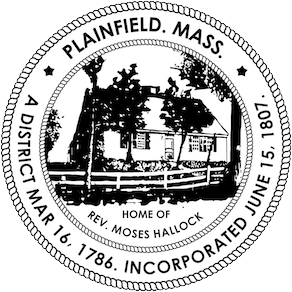
But now, having sufficient land, population and, since, a settled minister, Plainfield became a town in 1807. The date celebrated as its founding is the date it became a District with its own name, town meeting and church.
The people who came to Plainfield to live had to buy their land from either one of the 30 “Proprietors” of Cummington or from the Hatfield people, or their descendants, to whom the land in the Equivalent had been assigned. Cummington had three Divisions, allotted at different times. Part of the Second Division to the west was taken off to help establish the town of Windsor, and the Plainfield settlers bought what remained, and the land of the Third Division to the east (Barnard’s Grant) had been apparently inadvertently, included in No, 5 (Cummington) and when it was discovered those who had settled in that 600 acres had to buy their land over again from the Barnard’s, who were principally in Deerfield at that time. This fact is clearly attested to by the deeds.
The Mayhew Grant had passed into the Wainwright family by marriage, and was held by them as a family. They had an overseer of the tract in Deacon James Richards who bought a lot in Plainfield that lay contiguous to “the Grant” on the southwest corner. This arrangement was held until May 1, 1830 when on that date the 9th or 10th, lots into which the Grant was divided were sold out, making all the Plainfield land owned by individuals. This was later changed somewhat when industries were begun and companies formed. This is the arrangement of Plainfield according to the land. The original map of the layout exists in Cummington.
The town government was composed, as of most towns on the Commonwealth were, of three Selectmen, a Clerk, School Committee, Tax Collector, Treasurer, Highway Surveyors, School District, according to the young population; Assessors and later Overseers of the Poor; the last two offices held, usually, by the Selectmen. Town Meeting was held annually in March and specially whenever the Selectmen needed the opinion or approval of the Town for the business thereof. There were several Justices of the Peace to help the town and the people in their legal business, especially witnessing deeds, and officiating at marriages, if there was no minister available, something that seldom occurred.
The Town also ran the business of the Church for the first 60 years. Church officers being chosen by the Town. It troubled few of that time, for most were of the same religious persuasion and there was little difficulty that way.
Of course one of the chief requirements for a Town was that it should have a “settled learned minister.” Many of the people who came here were from Abington, Bridgewater and Weymouth, and had probably had the benefit of regular preaching, and knew its value. Several ministers preached here, from accounts in the records, but it was not until 1792 that young Moses Hallock, from Goshen, a graduate of Yale and also a former soldier in the Revolution, was heard and decided upon. The first call he declined, owing to the state of his health, but the second call was accepted and Plainfield received into her midst a man whose influence was to go halfway around the world
.The Meetinghouse was raised in the spring of 1792, Moses Hallock, by his own account, being present at that rejoiced occasion. He bought land on the west side of Central Street in the Upper village, and his house was much was like that at the Albert Farms/ Waryjasz, 166 East Main Street ( where so many potatoes have been grown in recent years). We do not have that house any longer, it fell victim to children with matches in the barn. It was felt as a sore loss but because people wanted to perpetuate the memory of Moses Hallock and his neighbor, Dr. Samuel Shaw whose house does still stand, money was given toward a town school and library which was built, and dedicated in September 1925.
Times have changed, the school now houses the town offices and one room of the library, devoted especially to the use of the children. This is extremely appropriate, for Moses Hallock, during 30 years of his ministry, held in his home, a private school for boys and girls, wherein he prepared young men, particularly, for college. This school soon became well known and very effective. For many years Williams College in Williamstown depended upon the students from Moses Hallock’s school for the greater part of their freshman class. One of these students was of the group famed for the “Haystack Prayer Meeting” which meeting was transferred from a grove to the space under a nearby haystack (built on a frame above the ground) by force of a sudden and intense rainstorm. This prayer meeting instituted the resolve which formed later the American Board of Commissioners for Foreign Missions the ABCFM. Of Mr.Hallock’s students, seven became foreign missionaries, and over the 30 years, 50 also became ministers.
There is no record of how many became capable business men, school teachers (women taught the spring and fall schools, men the winter ones when the big boys had time to go) and town officers. There were more than 300 students in his school in all. Many of them boarded in his home, sustained in their study of Latin and Greek and other necessary subjects, by a very plain and simple diet.
The town’s professional people consisted chiefly doctors. The country teachers were not considered to be professionals as they were usually young women who had graduated from the local one room schools and were felt to be capable of teaching school. Two attorneys, Cyrus Joy and William Cullen Bryant,practiced in town for short periods of time but did not find lawyers to be in much demand here.
In the 1980’s two or three attorneys bought homes in town but their law offices were “in the valley’ These were Doris F. Alden, Robert Gallagher and Robert A. Corash.
From the early days of the town there were always doctors in residence among them were Dr. Solomon Bond, Dr. Barney Tony, Dr. Jacob Porter, Dr_ Goodloe Taylor and Dr. Samuel Shaw, most of them lived in the Upper Village. Following them medical attention came from Cummington and Ashfield physicians. Just prior to World War II, Dr. Robert Carpenter came here to work and live. The war called and he was properly called to Washington to serve on the Surgeon General’s staff, much to the disappointment of the younger doctors he had recruited from the area to serve with him in Europe. Dr. Carpenter attained the rank of Colonel, a high ranking military officer.
The schools in town, starting with three, one in the center one in the southeast, and one on the west side of Mill Brook, gradually increased with the population until, as it reached its peak about 1835, there were nine school and districts and two that were shared, one with Hawley and one with Windsor. Most of the buildings were not large, and many could be moved from one location to another as the need arose by putting two large peeled trees under then in the manner of sled runners, and hitching on a sufficient number of ox teams to do the job of moving, Effort was made so that no pupil needed to walk more than 2 miles one way to school. It apparently made for sturdy scholars who were ready to sit down and attend to their studies after their arrival.The subjects taught were the usual reading, writing and arithmetic, also spelling, grammar, geography and some singing. A “spell down” was one of the entertainments much in favor both at school and for social occasions.
Of course, one of the things that the Proprietors in the beginning were very desirous of was establishing was a grist mill and a saw mill at convenient distances for the settlers Curnmington had one at each end of the town area but that was a long way for Plainfield folks. The Ford family from Abington, in the eastern part of the state, was very early arrivals in Plainfield territory. Two or three brothers came here from “Ford’s Farms” and seeing the need and the differences in terrain, established “Ford Mills” a saw mill and a grist mill. These were built on Mill Brook south of Lincoln Street, the grist mill north of the present foundations of the “Nash Mill” and the saw Mill almost touching the southeast corner of the Nash Mill These were probably the earliest mills in town, but not for long.
Samuel Streeter, of Sturbridge, bought Lots 60 and 70 of the First division of Hatfield Equivalent, which put him on the north side of the street in the Lower Village, Remember that these lots were 200 rods long, so that fact put him in possession of part of Mill Brook in the valley below the steep hill west of the church. Just when he built his saw mill there is not sure, but it was before the Meetinghouse was planned as he was asked to “turn out” farther in his road to his mill, so the Meetinghouse could be well situated on the acre of land he gave the town for its use.
It was fairly easy to decide where to build the Meetinghouse because the focus of the town was already on the street extending through the center of the Upper and Lower Villages. The Meetinghouse was at the west end and the main store and later, the Post Office, was at the east end of the street. Simon Borroughs owned the land on the north side of the road (Main Street) and Jonathan Munroe owned land on the south side of the street. Moses Hallock owned land on both sides of Main Street and the east side of Central and planted the many maples which grace the roadsides of Union and Central Streets. The idea spread and others took it up to give shade and protection to the roads. Levert Hallock, Moses’ son had maples planted along his property and the canopy of maples still survive (although the trees are ancient) along the roadside of “Barber Hill.” Samuel Streeter owned land north of Main Street in the Lower Village and his brother Daniel, who was a saddler, owned land on the south side, with another brother, Asa, owning land south of Daniel’s. He later moved to Cummington and started the Streeter farm. It sounds like a closed corporation, but it wasn’t. Samuel sold land along the street to others, gradually, and Daniel’s was divided among his children when he died suddenly, a young man.
In the Upper Village land about the four corners was gradually sold, a small piece at a time, until there were a store, two or three blacksmiths’ shops, a Gun House, a law office, two doctors’ homes and offices, a tavern, a shoemaker and other small shops whose ownership changed very often. At the Lower Village the Meetinghouse (flanked on each side by many horse sheds) stores, a hat shop dwelling, and eventually a hotel, made up the building there. A school was also built on the southeast corner of the lot(or as addition to it) that surrounded the Meetinghouse. But that was not all that grew. The brooks were fuller then, than now, and water power was what moved industry. Starting with the most necessary grist and sawmills and enterprising men, soon many other mills were in operation. Near Streeter’s mill his sons built a satinet factory, for making material for men’s trousers, and a cloth dressing shop, and later a grist mill. There were six good power sites on Mill Brook and all of them were extensively used at one time or another.
There were also a couple on the brook that came down from West Mountain by Liberty Street. There was a mill site on “Deer Hill Brook” on the southwest corner of town. On Meadow Brook that raises on the old Nash farm, north of the main cemetery, there were five or six power sites. On Grant Brook rising in Hawley and flowing, as its name indicates, through “the Grant” there were two or three, the last one being the pond and canal built on the southern end to run the saw mill built in Ashfield, near the Plainfield line, by Jessie Dyer, whose home was a small house on the Walter Rozell property. That family, as most who have owned that house, had come to Plainfield for church and sociability while the family that lived across the road had usually gone to Ashfield. The Dyer family has slowly gone west, as young people were commanded, the next stop being Albert Farms (166 East Main Street), the one after that the Persing’s (Central Street) and the last stop, held by the last Dyer in town, the Town Clerk’s home and office (344 Main St) next to the Town Hall.
When Church and State were separated, it was decided to build two new buildings, one for the Church and the other for the Town, coupled with the school for District #1. This was therefore done in 1846 and 1847. During that time the Church met for Sunday services in the ballroom of the hotel across the street from the church, (355 West Main Street). Since the house was turned back into a private dwelling from a hotel with a hall for meetings and recreation, the old hall has gone, and the house has become a one story building again. It had been raised from one to two stories and the second story removed in the 1950’s, thus losing all of the old building except the attic floor and the cellar.
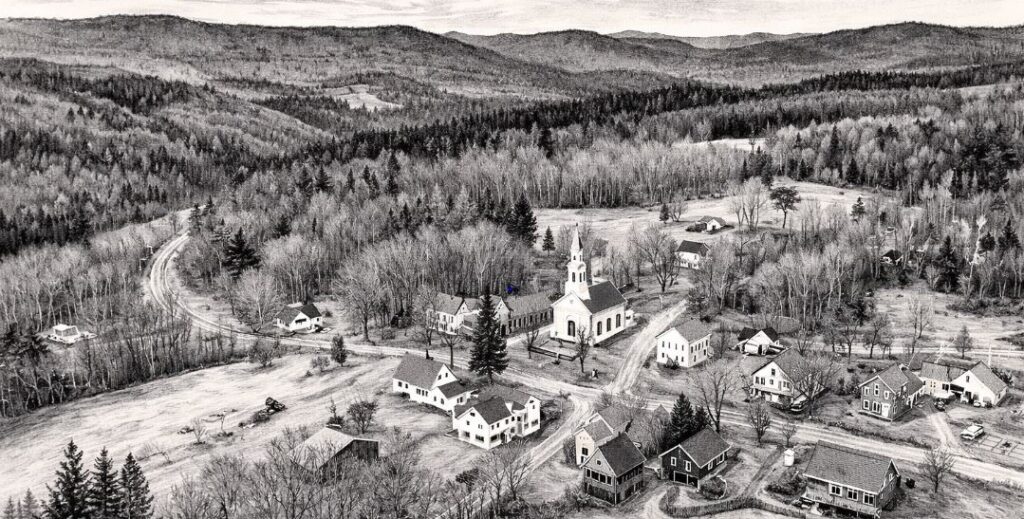
The Church and Town Hall, being built consecutively are matched as to facade and style, being, it is thought, the only such pair of town buildings in the area. Most of the early towns in this area have lost their original or distinctive churches by fire or other calamity. And Plainfield is pleased to be spared thus far, and so the village grew.
The Union Street Brook, south of the church has, however unbelievably, two mill foundations that are still visible. In the extreme east part of town Still Brook boasted the one that gave it its name. And in the extreme northeast was Scott’s sawmill, later a wood turning shop was added by the Thayer’s,Campbell’s saw mill that later became Billings. In it the lumber for the last house to be built of 2 x 4’s in town, C. N. Dyer’s store and Post Office, (344 Main St) now A. L. Dyer’s home and Town Clerk’s Office (until 2004 )was sawed. The houses of Randall Steele (43 S. Central St) and of Connell’s (1Church Lane) were built in the same way, and the house of Arnold Streeter and “Shep” Dyer was found to have been built that way when it was burning. That is to use 2 x 4 fastened together and laid like bricks,no uprights in the building except in cellar and attic. An advantage being, no wall plaster, and nails can be used wherever desired.
Some of the special things made in town are worthy of note. Satinet was made in the Streeter’s mill, cloth dressing and fulling were in the fulling mill on the island in Mill Brook. Further down on Mill Brook opposite the “Charlie Williams’ place”Silberberg’s there was a huge tannery with reportedly 100 vats for dressing leather. Further south on Mill Brook was another mill pond with a canal running from it across the road to the mill called “Walkouts Mill,” used for sawing and wood turning. The barn on the property was built of timbers sawed in the mill with a circular saw, speaking of more recent construction but what a barn!
Still, further south is probably the most famous mill in town, or rather its remains. This was the grist mill first of the Ford brothers and then of Jeremiah Robinson who lives at Stebich’s (16 Summit St). He was followed by Joseph Beals, the miller whose conversion made such an impression on his townsmen that its story was written by Moses Hallock’s son, William, in a tract that was circulated around the world, being an influence of untold benefit to many persons down through the years.
Further south yet was the mill of James A. Nash. Its foundation still stands, though trees and brush nearly hide it from sight at the road. This mill was running until about 80 years ago. Water was usually brought to the mill wheel from the mill pond through a canal but pictures show a flume, a long wooden tube made like a series of barrels placed end to end, used at the James Nash grist mill.
Upstream from Streeter’s mill was the saw and turning mill of George W. King which ran for some time. Above it, west of Main Street was the quite extensive foundations of the mill that was originally Isaac Sadler’s and later Homan Hallock’s. This mill is of especial note because here by employment of a turbine and steam was made type machinery. Homan Hallock, one of Moses Hallock’s sons, developed the method that turned brush written script into symbols that could be reproduced in type. He worked in Syria and Malta as well as Plainfield, in the production of Arabic type with which the Bible was printed in that language. The proof press that he used in his work is in the Plainfield Historical Society Museum presently in the Shaw Hudson House in the Upper Village.
On Meadow Brook, just North of Broom Street, was the saw mill of Joshua Shaw, an early one, not run in many years. His brother Thomas had a grist mill nearby and a mill stone is lodged under the overhanging bank of the stream near the brickyard. This brick yard was run by Thomas Shaw and several others. It is thought that it was running at three separate times, but the bricks from that yard are of a slightly different proportions, and unfortunately of a coarser material than the modern ones from other places, and with a little observation may be fairly easily identified. With this in mind it would appear that most houses of brick and also the brick chimneys on the old houses, at least, were made of the products of this yard. Some fifty odd years ago there were still, on the west side of the brook, opposite that spot where the higher banks recedes to the east, many cart loads of brick neatly laid out but now covered with a layer of soil and vegetation.
Further south at Pleasant Street were satinet mill and cloth dressing shops. They were large enough to require a large amount of help and a boarding house was built on the north side of Pleasant Street for the convenience of the help. A shop not requiring water power, was the window factory on the north side of Pleasant Street near Dan Urbans’s In it were made many windows, usually the large, four panes (2 over 2) ones. W. H. Dyer had the shop for some time and passed it by marriage to Irving McCloud.
On down the brook were woodworking and turning shops an the early saw mill of Ziba White. Still further south on Meadow Brook near “Saw Mill Hill”: was as indicated, an early saw mill and wood turning shop. Although the foundations were removed the canal from the dam to the mill is still visible. This, with the exception of the trip hammer that was established east of Davis Packard’s (now Alden’s) and was used to forge heavy metal for awhile, and the exception of the stills for spruce oil, and the cider brandy still on Still Brook which was run by the Stockwell’s completes the inventory of mill and powers sites in Plainfield as far as they are now know except for portable saw mill that came in and stayed a few months and moved on. The only saw mill in town now is owned by Wayne Phillips behind his home at 343 Main St. But one can never tell when an undiscovered deed or pile of stones, previously unnoticed, in a strategic spot will reveal further history that was forgotten.
Water power was not necessary for all industries, only when power was needed for the manufacture of shoes and boots, saddles, tacks, palm leaf hats, cheese boxes and baskets which were made in several homes and small shops. During the 1820’s and 30’s coppers tacks were made in town for the Shakers to be used in their boxes. There were at least two tack shops in town, one near the intersection of Grant and North Streets and one in the Upper Village, site unknown.
As far as the battle of the first settler goes, which has been “scrapped” over the many years, the
matter was pretty well decided by no lesser person than Ira Allen, brother of the celebrated Ethan Allen. It happened that Ira was in prison in France at one time, and as a time passer for himself, he proceeded to write an autobiography. The first volume was lost in his peregrinations, but the second volume was preserved and printed. In the second paragraph of the first page there of he tells an interesting tale of his adventures during one winter when at eighteen he guided a herd of pigs from Connecticut up into the Berkshires where they might fatten on the beech mast in Hatfield Equivalent. He spent the greater part of the fall and winter on 1769 there at the house of Mr.McIntire, his wife and daughters, and when the snow finally came he drove the pigs through to Albany where he received a good price for prime hogs. So we know Mr McIntire was well established here by the fall of 1769.
The reason for the disagreement as to the first settler in this case is that Mr. McIntire’a house stood on what is now North Central Street but on that part which lay in the mile strip that we received from Hawley.
The Fords, as has been noted, were very early settlers in the south central part of Plainfield.
Andrew Cook was in the southeast corner of Plainfield, near James Loud estate, (Swift River Inn) in 1779, at least that is when he made his purchase. Most of the settlers were in the central and southeastern part of town about 3/4 of a mile from the northern and western bounds. That does not mean that no one lived in those areas, just that the houses were further apart. There was a good high range of hills from north to south between the center and the western part of town. There were six separate summits with West Mountain, the highest point in the county, lying about in the middle. It used to be a wonderful place for picnicking because many of the farmers kept sheep who ate the greenery close to the ground, disclosing a magnificent view from the smooth ledgey top. The sheep are gone and so is the view.
The ponds in the area were and are good spots for boating and bathing, and many people have availed themselves of locations along the shores. North Pond and South Pond were both well known, North Pond has now become Plainfield Pond, and is used for boating and swimming. By vote of the Town in the 1920’s its name was changed to Lulu Bocton (?) To honor a much respected couple who lived on its shore, but the name did not survive. South Pond is now Windsor Pond, and once had a beach almost unrivaled, which now has been spoiled by private ownership.
Most of the people in Plainfield were farming folk. There were, of course, storekeepers and tradesmen, and a lot of people had a “side line” by which they could earn some cash for emergencies, but most of the business was carried on by trading. Taxes, however, had to be paid in cash and it was often a difficult matter. Many properties were mortgaged, as time went on a number were sold for taxes.
Many men bought land as an investment. One man, John Mack, keeper of the Brick Store, died young. He was a land purchaser and his widow, who had young children, had a large task before her to straighten out the land deals and get the surplus property sold. It would appear that, as she was a daughter of one of the first Deacons, she had attended Moses Hallock’s school as a young girls, and she seemed equal to the task, and she has her brother, also a probable student of Moses Hallock’s , and a Justice of the Peace to help her. It took several years to get things all straight and there are many pieces of land in town that were owned at one time by John Mack Esq..
Another of Moses Hallock’s sons, Leavitt, became a merchant and a manufacturer. Plainfield Pond (North Pond) drains northerly into Hawley, and the outflowing brook runs down through a narrow gorge, a prime place for dams and ponds and waterpower in quantity. Leavitt bought this property and on it he built a was mill and tannery that employed many people. There were several dwelling houses, a boarding house, a store, tailor shop, a blacksmith shop and barns, all together quite 4 village. The business went well. It was noted that during the 1840 presidential campaign, which was a particularly warm one, with a lot of activity, that a long wagon drawn by 13 pairs of oxen and with 49 passengers came over to Plainfield to join in the political activities there. Wonder has often been expressed as to how that wagon negotiated all the bends and curves on the road from Hallockville, where the tan works were, to Plainfield.
All was not joy and gladness in Hallockville, for the works burned in a tremendous fire, and while the main buildings were rebuilt, it was not run again. Later Leavitt Hallock moved to Amherst where he seems to have dealt successfully in real estate in fact there is a street there named for him.
Fire was always a danger, with wood burning stoves as well as with open fireplaces. The woolen factory owned by the Streeters burned twice and was rebuilt once. Whether other buildings were also burned either time we are not told, but fire fighting, even with the mill pond there, was not always successful. Wood fires also often occurred. One in the western part of town burned the H. Clark Packard place and No. 6 school, the house was unoccupied it was reported. Fifty years later the day fire swept the same general area burning over some 250 acres before it was brought under control.
Though business appeared to be good usually, the panic of 1838 had its repercussions in Plainfield. A number of families had answered the call “Go west, young man” and as those who went wrote back saying how large the country was, and flat, many others were persuaded. After about 1835 the population showed a gradual decline. For those who remained, life appeared to go about as usual.
Moses Hallock had, however, closed his school in about 1825, and some five years later he asked that an assistant pastor be hired who could continue the work of the Church when he was no longer able. The first man hired proved unsatisfactory and was dismissed. A later one was more successful. Moses Hallock died. much lamented in 1837.
It was about this time the Baptist Church was formed in the eastern part of town. Savoy and Ashfield were well supplied with Baptists and it is natural that Plainfield neighbors should be persuaded similarly. The church stood in the “Y” of East Street, now Alden Lanes and Main Street, where the Moute cottage now stands [138 East Main St]. A small pool in Grant Brook below the East Street bridge is said to have been used by them as a baptismal pool. They had several different ministers an elders over 30 some years that the church stood, Eggleston and A. H. Sweet being the two most cared for and longest kept. A.. H.. Sweet lived on town some time after he ceased to be an elder in the Baptist Church. For a short time there was also an Advent chapel just west of Plainfield Pond.
The quiet and content of the small town was broken into by the Civil War. While the town records show little of the impact of the war on the town, there is a whole small notebook full of names of the boys who went into the service and where they went. There had been Militia companies for many years. During the War of 1812 several local militia men were in the units which were sent to guard the port of Boston. They trained on the common in the Upper Village east of the Brick Store, and there was also a Cavalry unit and an Artillery Company, the latter was made up of men from several of the hill towns. They were centered at first in Williamsburg, then Goshen, then lastly Plainfield. The old Gun House that stood northwest of the common became unuseable, and by agreement with the Commonwealth another was built in the Lower Village, just east of Wayne Phillip’s [343 Main St] house on the south side of Main St. There was more room here to maneuver, if it was needed. Therefore, it was not green and untrained boys who answered the call of Lincoln as the war progressed for “600,000 more!” Some of the older men, when drafted, obtained substitutes, some were local but some were hired from the Boston vicinity to fill Plainfield’s quota, and at the final total Plainfield had furnished some half dozen over all calls. Of course with such bitter struggle as that, not all came back. One lies on Island 21 in the Mississippi. One, the only black in Plainfield’s list, lies in Andersonville cemetery where he was, after being wounded and taken prisoner in the battle of Olustee in Florida. Some served at Gettysburg where one is buried. Another man, older than some of the rest, got through the fighting and was put on a ship to come home. He was wounded and not well beside. Though good care was taken of him, he got lower and lower in his abilities arld succunabedjust before reaching Boston. But the majority came back!
However, having seen much more of the world then could have imagined, many decided to see if they could find work elsewhere, preferably in the west, and so the population declined further. The Boys in Blue who stayed, organized the Mountain Miller Post of the G. A. R.(Grand Army
of the Republic) and kept it going many years. Finally the last man left, Shepard R. Dyer, turned over the equipment of the Post to the Plainfield Grange asking it to carry on Memorial Day exercises in honor of the Grand Army and in its stead and that has been done through most of the life of Plainfield Grange which started in 1903, before the time the G. A. R. was finishing.
Fourth of July celebrations were special in Plainfield. Reports are imperfect, but it seems that in 1837 the militia simulated a battle between Colonists and Indians, carried on with such abandon that there were many windows broken in the Meetinghouse. After that grand celebration things appear to have quieted down. The last Fourth of July celebration was our impromptu parade held in 1976 while the church bells here and nationwide were pealing out in celebration on the 200th anniversary of our nation.
After that people were getting their excitement from the arguments and debates in Town Meeting. These took place not only at Town Meetings but also when people meet in the course of trading at the store. There were stores on town from Dr Solomon Bond’s and Jonathan Perkins’s store in the Upper Village in the 1790’s until the 1960’s when Warren Carver’s store in the Lower Village, run by Ciwate Sadowski was closed. John Mack (278 East Main St) had the “Brick Store” in the upper village, built in the early 1800’s. It was run successively by his sons John and Elisha Mack, Abner Gurney, Whitney Hitchcock, Shaw and Stowell, Wanton C. Gilbert and others until the days of Harold S. Packard who ran it until his death in 1935. Isaac K. Lincoln ran a store over in the south east part of town for several years. George Vining Jr. owned by never operated, a store in the West Hill area. He preferred to lease it to others.
In the Lower Village ham Packard operated a store in the building now owned by the Kings on the corner of Main and Union Streets. (353 West Main St) It too, had many owners in it’s forty years of existence among them Jacob and Levi Clark, across Union St., Ira Hamlin had a hatters shop (347 Main St). Levi Campbell purchased this about 1855 and opened a store there which too remained a store for over 100 years. He was followed by A. N. Gurney then by his grandson William A Packard, who sold to Warren Carver. Many people started stores as it seemed to them to be am easier way to make a living then farming, only to end in bankruptcy.
Campbell made the palm leaf hat industry a very profitable part of his business. The prepared palm leaf was furnished by the various merchants to the different families. The hats were braided by the women and girls. Although the pay was small at the time, probably three quarters of the families in town worked at this home industries which continued for over 30 years.
[This concludes the material written by Priscilla and Arvilla. Arvilla had hand written notes to be
included into the typed pages. I have tried to insert these where I think they were intended. I have tried to keep the integrity of their work but I have made some small changes and included house numbers where I knew them.I am sorry she and Priscilla were not able to complete a History of Plainfield, which they very much wanted to do. Nancy E. Allen ( 2006)]